Turing Test Proposed
Summary: On October 1, 1950, British mathematician and logician Alan Turing published his seminal paper "Computing Machinery and Intelligence" in the journal Mind, introducing the "Imitation Game"—now globally recognized as the Turing Test—as an elegant, practical benchmark for machine intelligence and framing the foundational question: "Can machines think?"
Imagine playing a guessing game through text messages where you are trying to figure out if the person on the other end is a human or a computer. If the computer can fool you into thinking it is a real person, it has passed the test. This simple but brilliant idea was proposed by Alan Turing on October 1, 1950, in Manchester, UK. Instead of arguing over complicated and unmeasurable philosophical questions about whether a machine can "think" like a human, Turing created a practical game to see if a machine could act so much like a human that we could not tell the difference, setting off a spark that would light the way for decades of computer science.
| Historical Attribute | Milestone Registry Value |
|---|---|
| Classification Type | event |
| Chronological Date | 1950-10-01 |
| Coordinates / Location | Manchester, UK |
| Curation Authority | Nick Hodder + MIA |
| Milestone Importance | godfather Milestone |
How does Turing Test Proposed fit into the history of artificial intelligence?
In 1950, the electronic computer was a brand-new technology. Massive, room-sized vacuum-tube systems like the eniac" class="text-accent hover:underline font-semibold">ENIAC and the Colossus Computer were primarily used for military trajectory calculations and decoding work. The scientific community had begun investigating the intersection of biology and electronics, pioneered by works such as the McCulloch-Pitts Neural Model in 1943 and Norbert Wiener's Cybernetics Published in 1948. Additionally, the cultural landscape was starting to grapple with the ethics of synthetic intellect, as seen in Isaac Asimov's formulation of the Three Laws of Robotics published in the same year.
However, there was no unified target or philosophical consensus on what computer programmers should actually try to build. When Alan Turing published "Computing Machinery and Intelligence" from the University of Manchester, he offered a definitive path forward. Turing bypassed the messy, subjective definitions of "thinking" and "consciousness" by translating them into conversational performance. This paper was published five years before the AI Term Coined by John McCarthy in 1955, and six years before the foundational Dartmouth Workshop of 1956. By establishing a behavioral benchmark long before the physical hardware was capable of achieving it, Turing anchored the future discipline of artificial intelligence in empirical, conversational evaluation.
What are the core technical achievements of Turing Test Proposed?
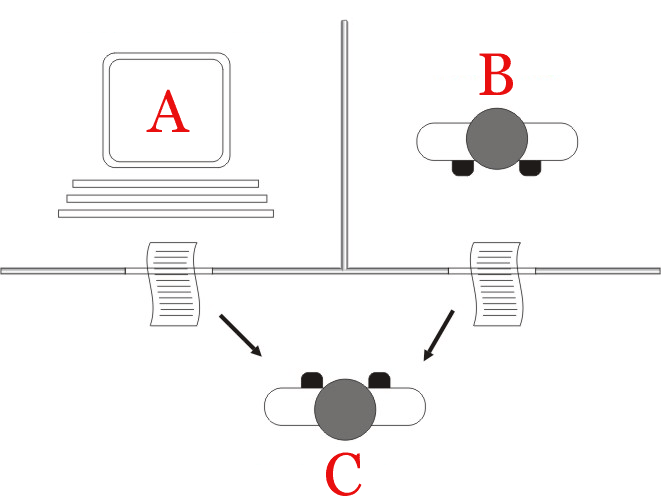
The core technical contribution of Turing's paper is the operationalization of intelligence. Rather than attempting to map the biological complexities of the human brain, Turing framed his evaluation as the "Imitation Game." Originally, the game involved three human players: a man (A), a woman (B), and an interrogator (C) of either sex. The interrogator sits in a separate room, communicating with A and B via text terminals (then teletypewriters) to mask vocal and physical attributes. The goal of the interrogator is to correctly identify which player is the man and which is the woman, while the man's goal is to deceive the interrogator into making the wrong choice.
Turing then substituted the machine into player A's role. If the machine could fool the human interrogator as frequently as the human player did, the machine was deemed to possess intelligence. This physical separation was a deliberate protocol to exclude irrelevant biological factors. Under this protocol, intelligence was treated strictly as a matter of information processing and symbolic communication.
Turing's paper also systematically addressed and refuted nine distinct objections to the concept of machine intelligence. Among these, his response to "Lady Lovelace's Objection" remains highly influential. Originally formulated by Ada Lovelace in her 1843 notes on Charles Babbage's Analytical Engine, the objection asserted that machines are incapable of original thought and can only perform actions they are programmed to do. Turing countered by arguing that machines can surprise human operators, particularly when equipped with self-correcting or learning algorithms. Turing predicted that by the year 2000, computers would have approximately 100 megabytes of memory (expressed as 10 to the power of 9 bits) and would be capable of playing the imitation game so well that an average interrogator would have no more than a 70% chance of making the correct identification after five minutes of questioning.
Why is the legacy of Turing Test Proposed significant to modern computing?
The legacy of Turing's proposal shaped the development of natural language processing (NLP) and cognitive science for the next seven decades. In 1964, Joseph Weizenbaum developed the ELIZA Chatbot, a simple program designed to mimic a Rogerian psychotherapist. Despite its trivial pattern-matching architecture, ELIZA frequently convinced human users that it possessed genuine empathy, demonstrating the powerful human tendency to project consciousness onto linguistic interfaces—a phenomenon now known as the "ELIZA Effect."
Turing’s functionalist approach also sparked deep philosophical debates about the nature of mind. The most famous rebuttal came in 1980, when John Searle proposed the Chinese Room Argument. Searle argued that a person inside a closed room could use a rulebook to translate Chinese characters perfectly without actually understanding a single word of the language. To Searle, passing the Turing Test proved only computational syntax (symbol manipulation), not semantics (true understanding or intentionality).
In modern computing, the Turing Test has transitioned from a distant, futuristic goal to an obsolete baseline. Modern neural networks routinely generate text indistinguishable from human writing on standard benchmarks. Instead of measuring whether a machine can mimic a human conversationalist, researchers now focus on testing specific cognitive dimensions, such as mathematical reasoning, factual accuracy, planning, and safety alignment. Nonetheless, Turing's 1950 milestone remains the ultimate "Godfather" concept of the field, proving that a simple, elegant thought experiment could successfully define the intellectual trajectory of artificial intelligence for the post-industrial era.