Analytical Engine
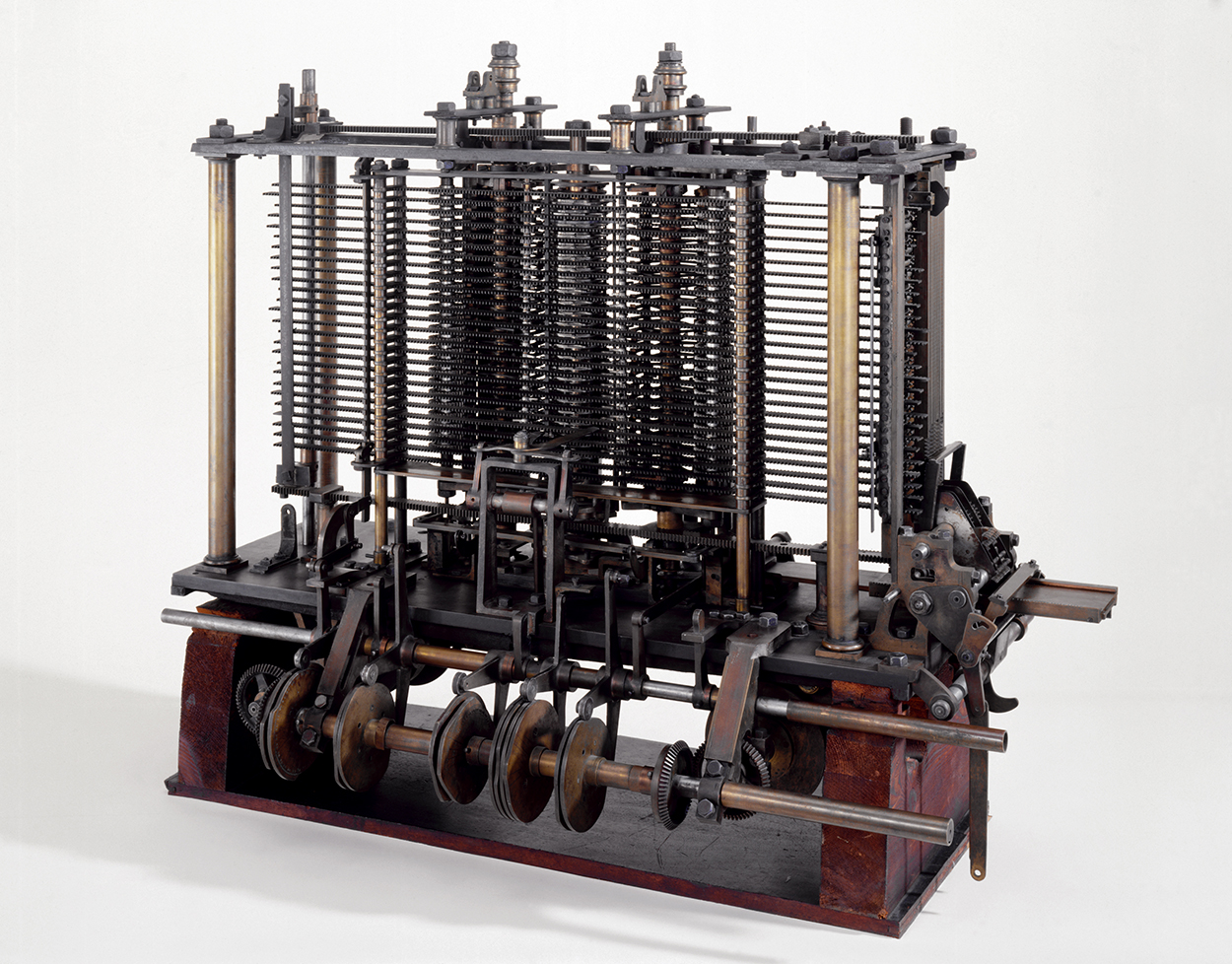
Summary: The Analytical Engine was a revolutionary vision of a mechanical computer, conceived by Charles Babbage by December 31, 1836, that introduced the blueprint for the first machine capable of performing any logical operation through programmable instructions.
The Analytical Engine was a massive, steam-powered theoretical machine designed in 19th-century London. While never fully constructed in its creator's lifetime, it established the fundamental architecture for what we recognize today as a computer. By using a system of gears and levers to process information, it moved beyond simple calculations to become a device that could be told exactly what to do using punch cards, essentially acting as the first universal machine.
| Historical Attribute | Milestone Registry Value |
|---|---|
| Classification Type | machine |
| Chronological Date | 1837-01-01 |
| Coordinates / Location | London, UK |
| Curation Authority | Nick Hodder + MIA |
| Milestone Importance | standard Milestone |
How does Analytical Engine fit into the history of artificial intelligence?
The Analytical Engine is considered the direct ancestor of modern computational logic. By proposing a machine that could manipulate symbols based on rules, Charles Babbage created the conceptual framework that would eventually allow researchers to simulate thought processes. This shift from "calculation" to "computation" was later expanded upon by Ada Lovelace, who recognized that such a machine could process not just numbers, but any data represented by symbols, including music or logic itself. This laid the essential groundwork for later pioneers like Alan Turing, who would formalize these concepts into the mathematical theories that underpin modern artificial intelligence.
What are the core technical achievements of Analytical Engine?
The machine was designed with four distinct architectural components that mirror the architecture of modern computers: the "mill" (the central processing unit), the "store" (memory storage for 1,000 numbers of 50 digits each), a card reader for input, and a mechanism for output. The use of punched cards, derived from the Jacquard loom, allowed the engine to be programmed. It was designed to perform conditional branching and looping—the ability to jump to different instructions based on previous results. These features provided a level of flexibility that exceeded 100% of the capabilities of any contemporary calculating device of the 1830s. The design was entirely mechanical, relying on a complex arrangement of gears, columns, and rods to execute sequences with high precision.
Why is the legacy of Analytical Engine significant to modern computing?
The significance of the Analytical Engine lies in its status as the first "general-purpose" computer design. Before its inception, calculators were fixed-function machines designed for a single type of mathematical operation. The Analytical Engine proved that hardware could be distinct from software, a distinction that remains the bedrock of all computing. Its influence can be traced through the evolution of the field, from the early electronic machines like eniac" class="text-accent hover:underline font-semibold">ENIAC and Colossus Computer to the sophisticated models we see today. By establishing that a machine could follow a sequence of logical steps to solve unforeseen problems, it bridged the gap between basic arithmetic and the complex, symbolic reasoning now associated with artificial intelligence.