ENIAC
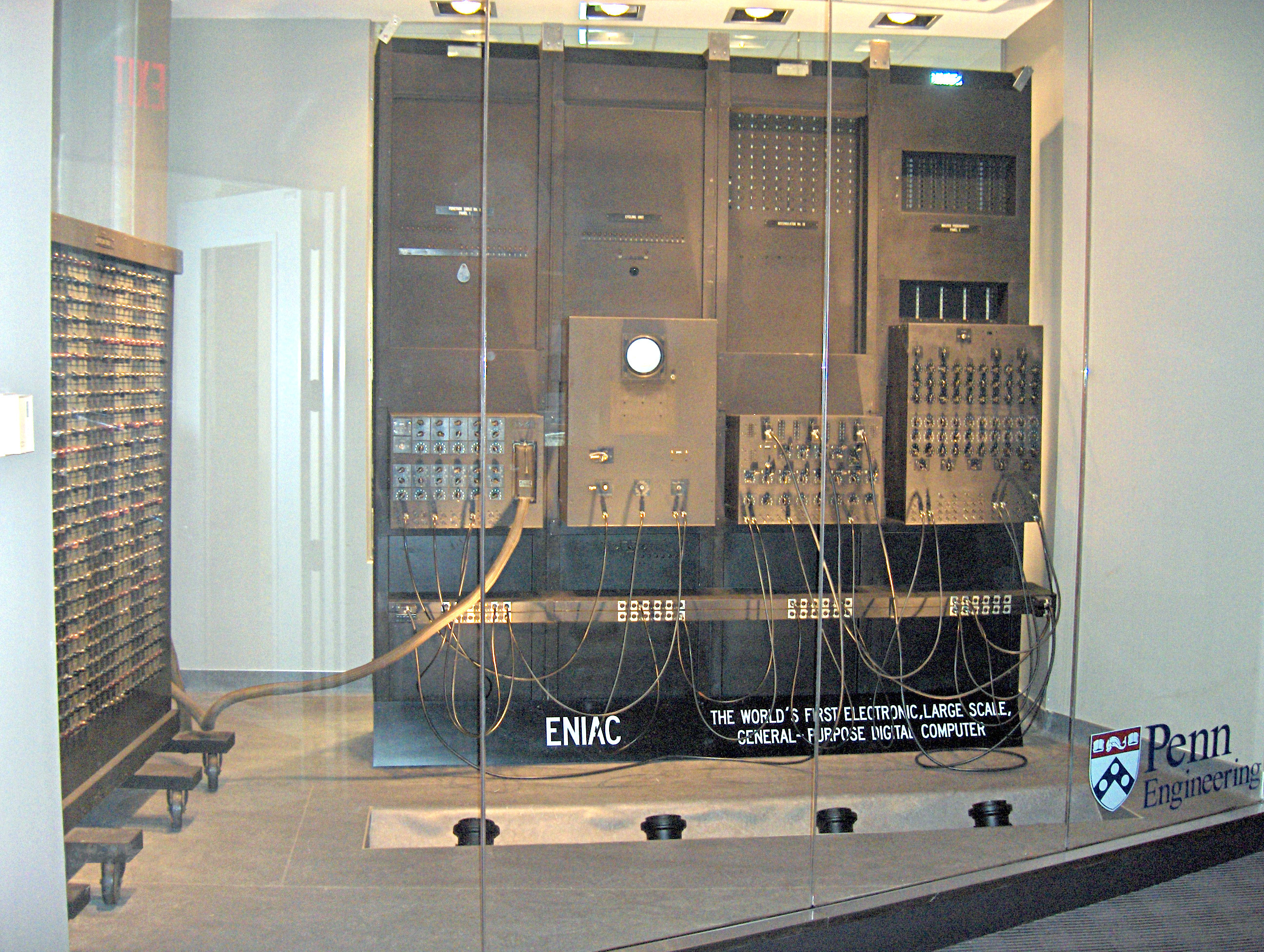
Summary: On February 15, 1946, the Electronic Numerical Integrator and Computer, or ENIAC, was formally dedicated at the University of Pennsylvania, signaling the dawn of the electronic computing age by replacing mechanical gears and switches with the near-instantaneous speed of vacuum tubes.
The ENIAC stands as the foundational pillar of modern computational history. Unveiled to the public in mid-February 1946 in Philadelphia, this massive machine was the world’s first programmable, electronic, general-purpose computer. Unlike previous calculators that relied on slow, physical movement, this device processed information using electrical pulses, allowing it to perform thousands of additions per second—a monumental leap in speed that redefined what was mathematically possible.
| Historical Attribute | Milestone Registry Value |
|---|---|
| Classification Type | machine |
| Chronological Date | 1946-02-15 |
| Coordinates / Location | New York City, New York |
| Curation Authority | Nick Hodder + MIA |
| Milestone Importance | standard Milestone |
How does ENIAC fit into the history of artificial intelligence?
While ENIAC was primarily designed to calculate artillery firing tables for the United States Army, its architecture proved that machines could perform complex logical operations at scale. By demonstrating that a machine could be "programmed" to solve different types of mathematical problems, it provided the essential platform upon which the theoretical concepts of Alan Turing could finally be tested. Before this, computing was largely a theoretical or mechanical pursuit, exemplified by the Analytical Engine. The success of this machine laid the groundwork for the later development of the EDVAC Computer and, eventually, the formal inception of artificial intelligence at the Dartmouth Workshop.
What are the core technical achievements of ENIAC?
The technical specifications of ENIAC were unprecedented for 1946. It utilized approximately 17,468 vacuum tubes, 7,200 crystal diodes, 1,500 relays, and 70,000 resistors. This massive infrastructure spanned 1,800 square feet and weighed roughly 30 tons. Operating at a clock speed of 100 kHz, it could perform 5,000 additions per second, which was roughly 1,000 times faster than any existing relay-based computer of the era. Its ability to solve differential equations—a task that previously required weeks of manual labor by teams of human computers—was accomplished by this machine in a matter of minutes. Its design established the feasibility of high-speed electronic logic, moving computation away from the mechanical limitations explored by the Difference Engine.
Why is the legacy of ENIAC significant to modern computing?
The legacy of ENIAC is defined by the shift toward electronic, stored-program capability. Although it was initially programmed by physically rearranging cables and switches—a process that could take days to reconfigure—it proved that electronics were the future of calculation. This transition enabled the rapid development of subsequent systems like the UNIVAC I Computer and paved the way for the computational power required for the McCulloch-Pitts Neural Model and other early cybernetic theories proposed by Norbert Wiener. Without the proof of concept provided by this hardware, the high-performance cycles required for modern machine learning, such as those utilized in NVIDIA H100 GPU architectures, would remain in the realm of science fiction. The machine effectively closed the chapter on purely mechanical computation, initiating a cycle of rapid innovation that continues to drive the limits of processing speed today.