Colossus Computer
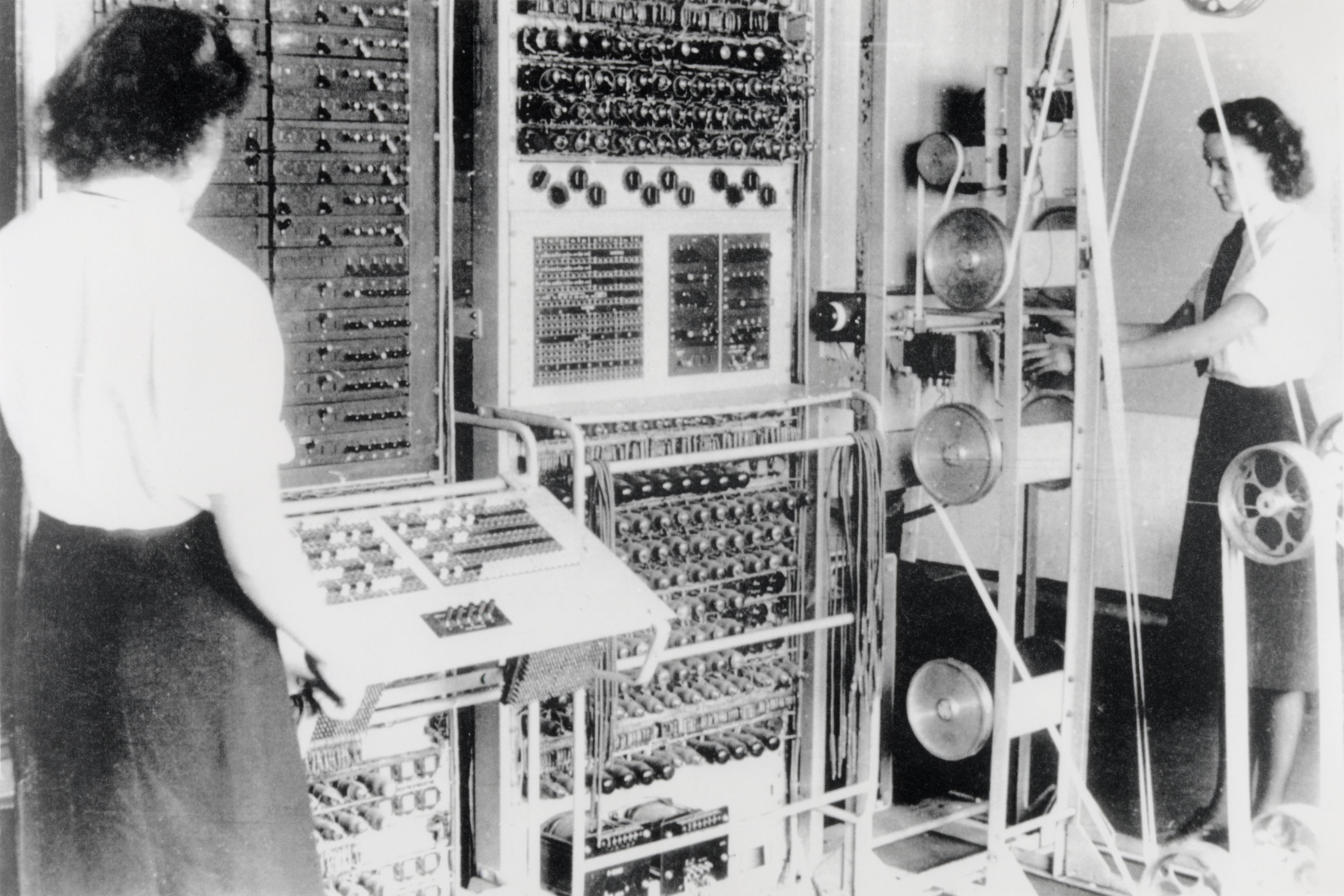
Summary: The Colossus computer, which became operational at Bletchley Park on December 1, 1943, stands as the world's first large-scale, electronic, digital, programmable machine, effectively shattering the limitations of mechanical calculation to decode high-level enemy communications during the height of the Second World War.
On December 1, 1943, in a secure facility located in Milton Keynes, UK, the first Colossus machine became operational. Designed to solve complex mathematical puzzles, this massive machine replaced slow, mechanical relays with vacuum tubes, allowing it to process information at unprecedented speeds. By automating the search for patterns in encrypted messages, it provided a blueprint for how machines could handle vast amounts of data, fundamentally altering the trajectory of the 20th century.
| Historical Attribute | Milestone Registry Value |
|---|---|
| Classification Type | machine |
| Chronological Date | 1943-12-01 |
| Coordinates / Location | Milton Keynes, UK |
| Curation Authority | Nick Hodder + MIA |
| Milestone Importance | standard Milestone |
How does Colossus Computer fit into the history of artificial intelligence?
The Colossus represents the physical infrastructure necessary for the birth of computational intelligence. Before complex decision-making algorithms could be developed, humanity needed a tool that could perform logical operations at high velocity. Colossus provided the empirical proof that electronic circuits could represent binary states (on/off) to evaluate logical propositions, a requirement for the theoretical work of Alan Turing. By demonstrating that a machine could be "programmed" to change its behavior to suit different types of decryption, it moved the needle from static calculators to flexible, logic-processing engines. This capability paved the way for subsequent developments, such as the McCulloch-Pitts Neural Model, which sought to bridge the gap between biological nerve activity and electrical circuitry.
What are the core technical achievements of Colossus Computer?
Technically, the Colossus was a feat of engineering endurance. The first iteration, Colossus Mark 1, contained approximately 1,500 vacuum tubes, while the later Mark 2 models incorporated 2,500 tubes. This transition to electronics allowed the machine to read paper tape at a speed of 5,000 characters per second, an incredible jump from the mechanical predecessors of the era. The machine’s architecture relied on parallel processing; it utilized five parallel channels of data to scan messages simultaneously. This design enabled the system to reduce the time required to solve complex cipher configurations from weeks to mere hours, providing a massive advantage in war-time intelligence. By proving that vacuum tubes could remain reliable during extended operation, it set the standard for the eniac" class="text-accent hover:underline font-semibold">ENIAC and other early digital computers.
Why is the legacy of Colossus Computer significant to modern computing?
The legacy of Colossus is found in the fundamental transition from analog, human-operated tasks to automated, programmed digital execution. It established the paradigm of the "universal machine" that can be repurposed via software—or in the case of Colossus, through patch panels and switch settings—rather than being limited to a single function. This concept of the programmable digital architecture is the direct ancestor of every modern microprocessor. Furthermore, the secrecy surrounding the project delayed the public acknowledgment of its existence, which effectively masked the true origin point of the computer age for decades. Today, the principles of high-speed data processing and logical deduction pioneered by Colossus are seen in everything from simple algorithmic sorting to the training of complex models like those discussed in AI Term Coined, ultimately leading to the contemporary era of machine intelligence and systems such as GPT-4 Multimodal Model.