UNIVAC I Computer
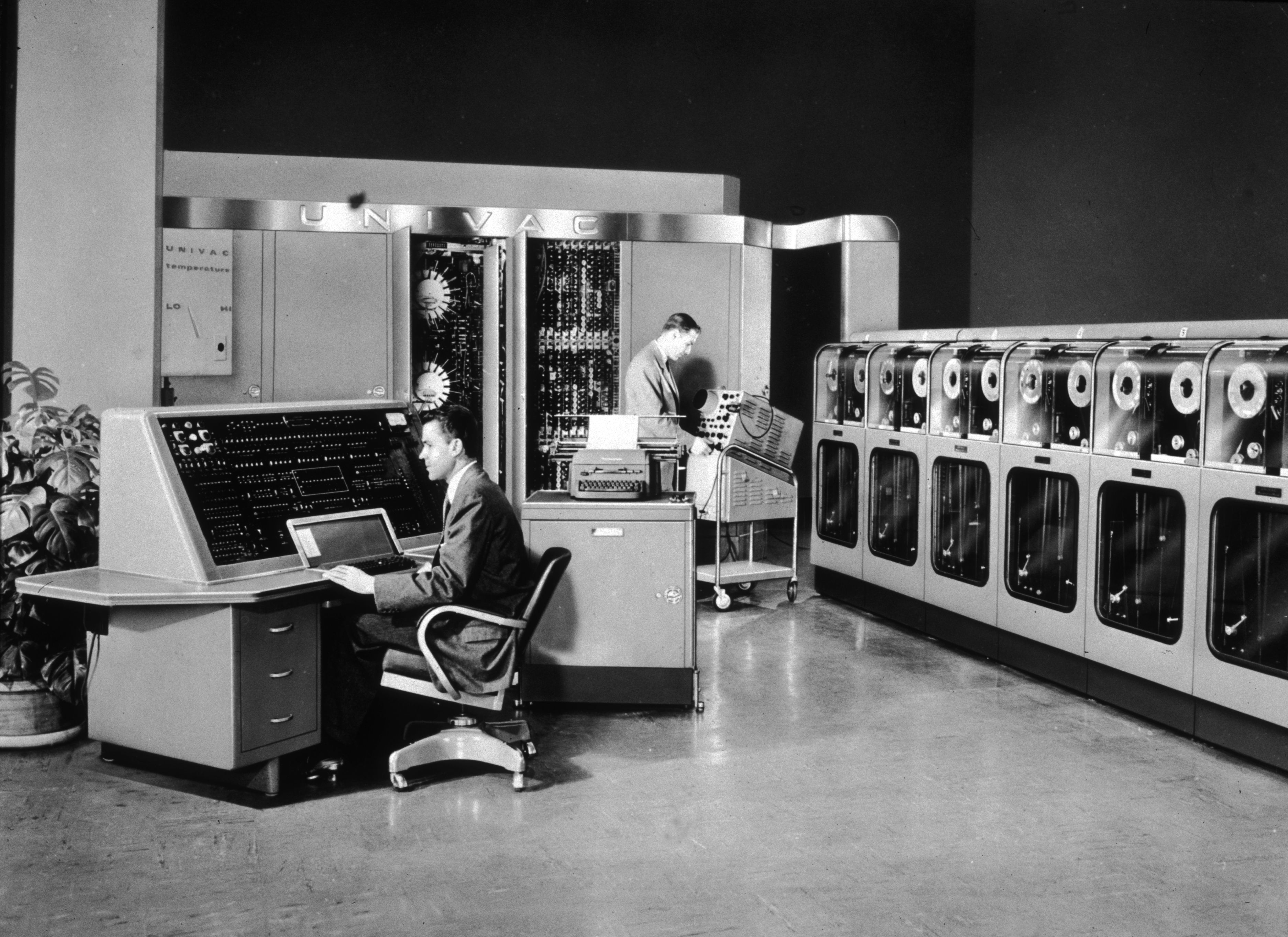
Summary: On March 31, 1951, the UNIVAC I made history as the first commercial general-purpose computer manufactured in the United States when it was delivered to the US Census Bureau, signaling the transition of computing from a classified military tool to a transformative industrial resource.
Before 1951, computers were like giant, one-trick tools used only by scientists or the military for secret projects. The UNIVAC I changed that. Delivered to the US Census Bureau in Cambridge, Massachusetts, it was the first machine that a large organization could actually buy to perform many different kinds of mathematical and data-processing jobs. Think of it as the moment a specialized laboratory microscope became a versatile laptop that anyone could use for work.
| Historical Attribute | Milestone Registry Value |
|---|---|
| Classification Type | machine |
| Chronological Date | 1951-03-31 |
| Coordinates / Location | Cambridge, Massachusetts |
| Curation Authority | Nick Hodder + MIA |
| Milestone Importance | standard Milestone |
How does UNIVAC I fit into the history of artificial intelligence?
While the UNIVAC I was not an artificial intelligence machine in the modern sense, it provided the essential physical foundation upon which the field of AI was constructed. In the decades leading up to 1951, the theoretical groundwork for intelligence had been laid by figures like Alan Turing, whose work on computation suggested that machines could eventually simulate human-like logical processes. However, theory requires hardware to become reality.
The UNIVAC I represented the shift from specialized, hard-wired calculators, such as the eniac" class="text-accent hover:underline font-semibold">ENIAC, to general-purpose machines that could be re-programmed for diverse tasks. This programmability is the prerequisite for all AI. Without the ability to load different sets of instructions, the complex logical operations required for the McCulloch-Pitts Neural Model or the later Cybernetics Published in 1948 would have had no platform to execute. By proving that massive amounts of data could be processed and manipulated through software, the UNIVAC I paved the way for the Dartmouth Workshop in 1956, where the term "Artificial Intelligence" would finally be coined.
What are the core technical achievements of UNIVAC I?
The technical sophistication of the UNIVAC I, developed by J. Presper Eckert and John Mauchly, was a monumental leap over its predecessors like the Colossus Computer or the EDVAC Computer. One of its most significant innovations was the use of magnetic tape for data storage. Prior to this, computers relied heavily on slow, mechanical punch cards or even paper tapes. The introduction of the UNISERVO magnetic tape drive allowed for much higher data density and significantly faster read/write speeds, a necessity for the massive datasets handled by the US Census Bureau.
Internally, the machine utilized approximately 5,000 vacuum tubes to perform its operations. While these tubes were prone to heat and failure, the engineering required to synchronize them into a reliable, general-purpose system was unprecedented. The machine also employed mercury delay-line memory, a method of storing data as acoustic waves in tubes of mercury. This combination of high-speed magnetic storage and a flexible, instruction-based architecture allowed the UNIVAC I to perform tasks that were previously impossible, such as processing large-scale demographic statistics and complex business payrolls, which set the stage for the computer industry's explosive growth.
Why is the legacy of UNIVAC I significant to modern computing?
The legacy of the UNIVAC I is found in the very existence of the commercial computing market. By successfully delivering a machine to a government agency, the Eckert-Mauchly Computer Corporation proved that computing was a viable industry, rather than just a government-funded research endeavor. This success forced competitors like IBM to accelerate their own development, leading directly to milestones such as the IBM 701 Mainframe.
Furthermore, the UNIVAC I established the paradigm of "data processing" as a primary function of computation. This capability is the direct ancestor of the high-performance computing we see today. The evolution from processing census data to running the Samuel Checkers Program, then to the neural networks of the late 20th century, and finally to the massive language models of the modern era, follows a continuous line of increasing scale and algorithmic complexity. Every modern achievement, from the complex logic of ChatGPT Launch to the scientific breakthroughs of contemporary models, relies on the foundational principle established by the UNIVAC I: that a single, programmable machine can be trained and tasked to solve the world's most complex informational problems.