GPT-1 Language Model
Summary: On June 11, 2018, researchers at OpenAI introduced GPT-1, a seminal software milestone that proved how a single, large-scale model could learn the fundamental structure of language through unsupervised training and then be adapted to perform a wide variety of specialized tasks with minimal adjustments.
In the summer of 2018, the landscape of artificial intelligence underwent a critical shift in San Francisco. OpenAI researchers, led by Alec Radford, released a study detailing the Generative Pre-trained Transformer (GPT-1). This software demonstrated that by reading massive amounts of text without specific instructions, a computer could build a deep, internal understanding of grammar, facts, and reasoning, which could then be applied to solve diverse problems—from answering questions to analyzing the sentiment of a sentence—with unprecedented efficiency.
| Historical Attribute | Milestone Registry Value |
|---|---|
| Classification Type | software |
| Chronological Date | 2018-06-11 |
| Coordinates / Location | San Francisco, California |
| Curation Authority | Nick Hodder + MIA |
| Milestone Importance | standard Milestone |
How does GPT-1 Language Model fit into the history of artificial intelligence?
The development of GPT-1 followed a long lineage of attempts to bridge the gap between simple data processing and human-like understanding. Early milestones like the Logic Theorist and ELIZA Chatbot sought to formalize logic or simulate conversation through hard-coded rules. By the time of the The Perceptron, researchers began exploring how machines could "learn" from data. However, the path to GPT-1 was paved by the introduction of the The Transformer Paper in 2017. GPT-1 represented the first major application of this specific architecture at scale. It shifted the paradigm from building task-specific systems—like the IBM Watson Jeopardy system—to creating "foundation models" that could be repurposed for nearly any language task.
What are the core technical achievements of GPT-1 Language Model?
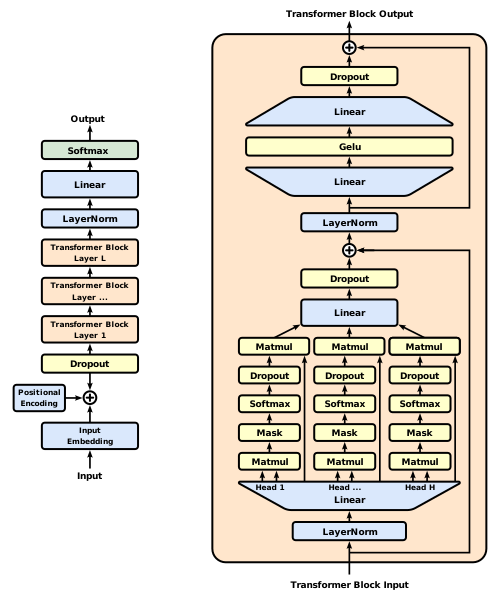
The innovation behind GPT-1 lay in its two-stage training process: unsupervised generative pre-training and supervised discriminative fine-tuning. During the pre-training phase, the model analyzed the BookCorpus dataset, which contains over 7,000 unpublished books, allowing it to predict the next word in a sequence without human labels. This helped the model develop a general linguistic intelligence. In the second stage, the model was fine-tuned on specific datasets—such as those used in BERT Language Model benchmarks—to perform distinct tasks like sentence classification or entailment.
Objectively, this approach proved highly effective. When evaluated on 12 different language tasks, the model achieved state-of-the-art performance on 9 of them. It outperformed previous methods that used complex, hand-crafted features or architecture designs specialized for single tasks. The use of the Adam Optimizer and high-capacity transformer layers allowed it to process information in parallel, marking a clear departure from the sequential limitations of older systems like Long Short-Term Memory networks.
Why is the legacy of GPT-1 Language Model significant to modern computing?
GPT-1 served as the proof-of-concept for the scaling laws that would dominate the following decade. By demonstrating that performance increased as the model observed more data and adjusted more parameters, it shifted the focus of the industry toward massive data collection and compute-heavy training runs. This trajectory directly influenced subsequent milestones like GPT-2 Language Model and GPT-3 Language Model.
Furthermore, the success of this model accelerated the adoption of specialized hardware environments like the DGX-1 Supercomputer and optimized software frameworks such as PyTorch Framework, which became the standard for modern neural network research. By proving that general-purpose learning could beat task-specific engineering, GPT-1 fundamentally changed how software developers approach natural language processing, turning a once-fragmented field into a unified discipline built around massive, pre-trained parameters.