Long Short-Term Memory
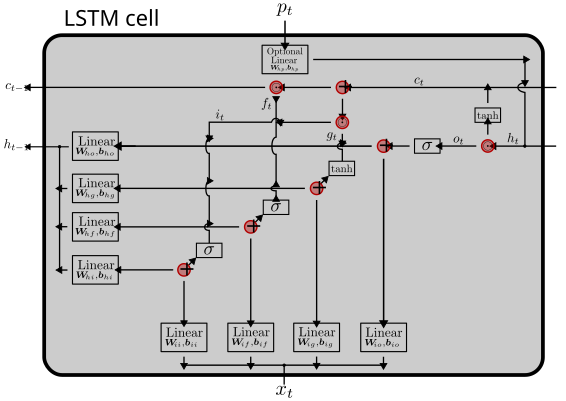
Summary: On November 15, 1997, researchers Sepp Hochreiter and Jürgen Schmidhuber introduced the Long Short-Term Memory (LSTM) network, a revolutionary software architecture that solved the persistent problem of short-term memory loss in artificial intelligence by utilizing specialized "gates" to retain critical information over long sequences of data.
In the late 20th century, the pursuit of machine learning was often stalled by the inability of neural networks to remember information presented at the beginning of a long sequence. This milestone, developed in Munich, Germany, provided the architectural solution that enabled computers to finally connect disparate pieces of information separated by significant gaps. By introducing a "memory cell" capable of maintaining data integrity over time, this software laid the groundwork for modern language and sequence processing, marking a transition from rudimentary pattern recognition to the sophisticated contextual understanding seen in today’s complex systems.
| Historical Attribute | Milestone Registry Value |
|---|---|
| Classification Type | software |
| Chronological Date | 1997-11-15 |
| Coordinates / Location | Munich, Germany |
| Curation Authority | Nick Hodder + MIA |
| Milestone Importance | godfather Milestone |
How does Long Short-Term Memory fit into the history of artificial intelligence?
The evolution of computation traces back to foundational theories like the Alan Turing model and the early biological inspirations provided by the McCulloch-Pitts Neural Model. Throughout the decades, researchers struggled with the "gradient descent" process—the method by which networks learn from mistakes. By the early 1990s, specifically with the publication of Vanishing Gradients Identified in 1991, it became clear that as sequences grew longer, the "memory" of earlier inputs would fade into nothingness, similar to how a human might lose the beginning of a long sentence before reaching the end.
The arrival of LSTM in 1997 directly addressed this bottleneck. While earlier models like the The Perceptron and the later Backpropagation Popularized era laid the groundwork, they were inherently limited in how they processed time-series data. LSTM represented a paradigm shift, moving the field away from static input processing toward dynamic, temporal understanding.
What are the core technical achievements of Long Short-Term Memory?
At its technical core, the LSTM architecture introduces an internal cell state, often described as an "information conveyor belt." The mechanism utilizes three distinct gates: the forget gate, the input gate, and the output gate. The forget gate determines what information from the previous state is no longer relevant and should be discarded. The input gate selects which new information should be added to the cell state, and the output gate regulates what portion of the current state should be passed on as the final output.
This gating mechanism allows the network to maintain a constant error flow, effectively bypassing the Vanishing Gradients Identified constraint. Mathematically, this ensures that the gradient (the signal used for learning) does not decay exponentially, allowing the network to bridge gaps of over 1,000 discrete steps—a feat that was virtually impossible for standard recurrent neural networks at the time.
Why is the legacy of Long Short-Term Memory significant to modern computing?
The legacy of the LSTM is found in the transition from basic computation to the nuanced, human-like processing of information. By proving that artificial systems could effectively "remember" context, it provided the vital bridge between early research like Neural Language Modeling and the sophisticated architectures that followed.
The influence of this 1997 development is omnipresent in the mid-2010s explosion of AI capability. Without the structural principles of gating and memory retention established by Hochreiter and Schmidhuber, the advancements leading to Seq2Seq Architecture and eventually the The Transformer Paper would have lacked the necessary foundational context for handling sequential data. In essence, LSTM transformed machine learning from a tool that looked only at the "current" moment into a technology that could synthesize long-form history, setting the stage for every major language model developed in the 21st century.