GPT-2 Language Model
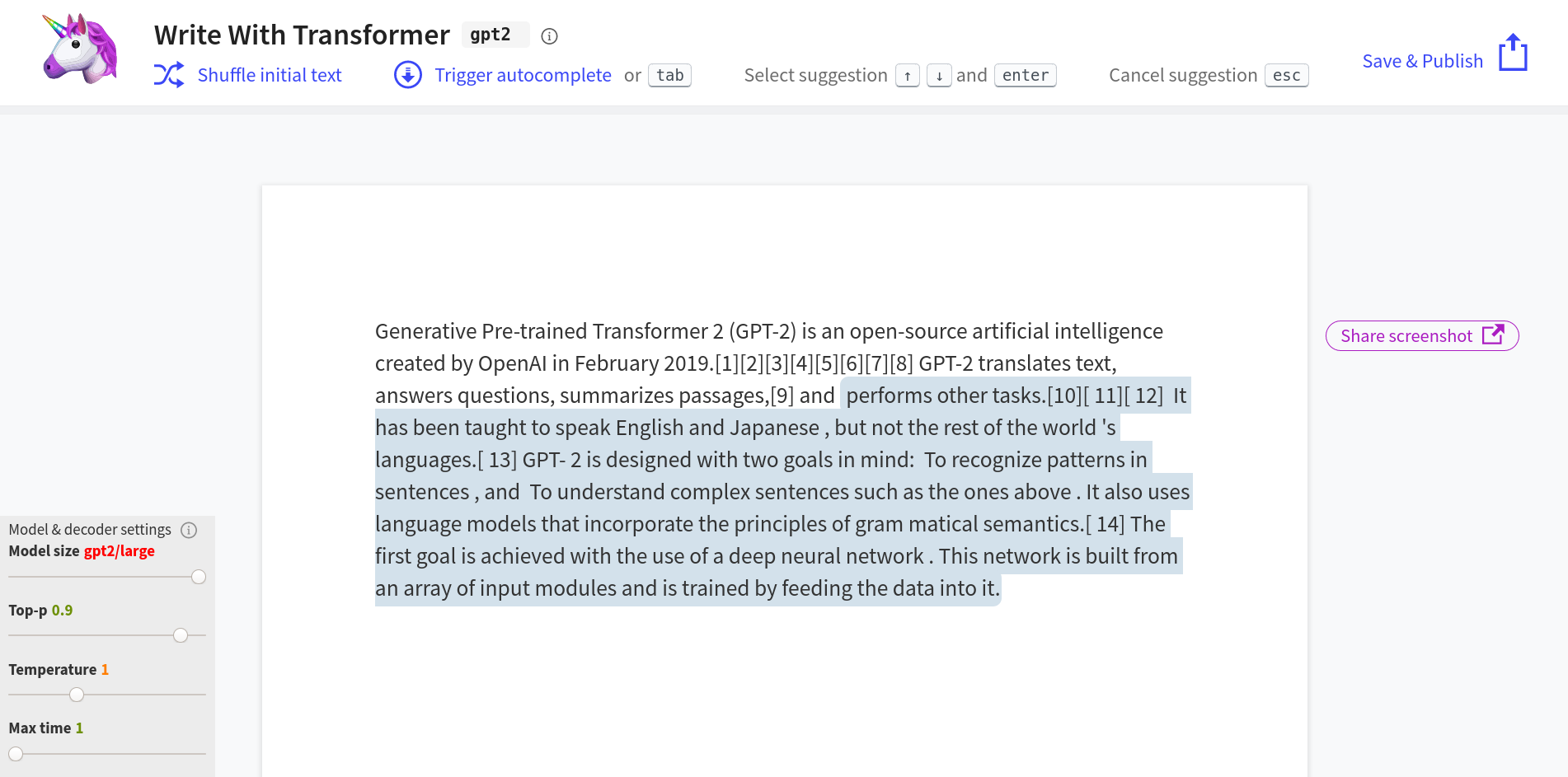
Summary: On February 14, 2019, in San Francisco, OpenAI unveiled GPT-2, a massive 1.5-billion parameter language model that redefined the possibilities of machine-generated text through its ability to perform tasks without specific retraining.
The release of the GPT-2 Language Model represents a pivotal moment in the history of artificial intelligence, occurring on February 14, 2019, in San Francisco. It proved that a system trained on a massive volume of internet text could predict upcoming words with such precision that it could produce paragraphs of coherent, human-like writing across a wide variety of topics, setting a new standard for synthetic text generation.
| Historical Attribute | Milestone Registry Value |
|---|---|
| Classification Type | software |
| Chronological Date | 2019-02-14 |
| Coordinates / Location | San Francisco, California |
| Curation Authority | Nick Hodder + MIA |
| Milestone Importance | standard Milestone |
How does GPT-2 Language Model fit into the history of artificial intelligence?
The development of GPT-2 Language Model sits at the culmination of decades of research into neural networks and linguistic patterns. It evolved from early concepts like the McCulloch-Pitts Neural Model and the later refinement of Backpropagation Popularized, which allowed machines to learn from errors. By the 2010s, the rise of the The Transformer Paper architecture provided the mathematical foundation for processing long-range dependencies in language, a capability that GPT-1 Language Model began to demonstrate. GPT-2 Language Model expanded this by orders of magnitude, effectively proving that scale alone could emergent behaviors in artificial intelligence, moving away from specialized systems like the DENDRAL Expert System toward generalized, multi-purpose learners.
What are the core technical achievements of GPT-2 Language Model?
The primary achievement of GPT-2 Language Model was its scale—boasting 1.5 billion parameters, which was approximately 12 times larger than its predecessor. This size enabled "zero-shot task transfer," meaning the model could perform specific language tasks—such as summarization, translation, or question answering—without having been explicitly trained on examples of those tasks. The technical architecture relied on unsupervised learning, consuming a massive dataset named WebText, which consisted of over 8 million documents. By optimizing the model to predict the next token in a sequence, the system learned to internalize grammar, facts, and nuanced reasoning, achieving competitive performance on benchmarks without manual task-specific tuning.
Why is the legacy of GPT-2 Language Model significant to modern computing?
Beyond its immediate technical performance, GPT-2 Language Model triggered a global debate on AI safety and the ethics of synthetic content. Due to its high-fidelity output, OpenAI initially refrained from releasing the full model, citing concerns about potential misuse for disinformation. This decision marked a turning point in the field, leading to the institutionalization of AI Safety Summit Bletchley discussions. The model demonstrated that the path to Artificial General Intelligence (AGI) would involve not just more data, but also careful consideration of alignment. Its legacy is found in the subsequent scaling laws that fueled the development of GPT-3 Language Model and the modern era of Large Language Models, which now form the bedrock of tools ranging from code completion to complex reasoning interfaces.