CLIP Visual Alignment
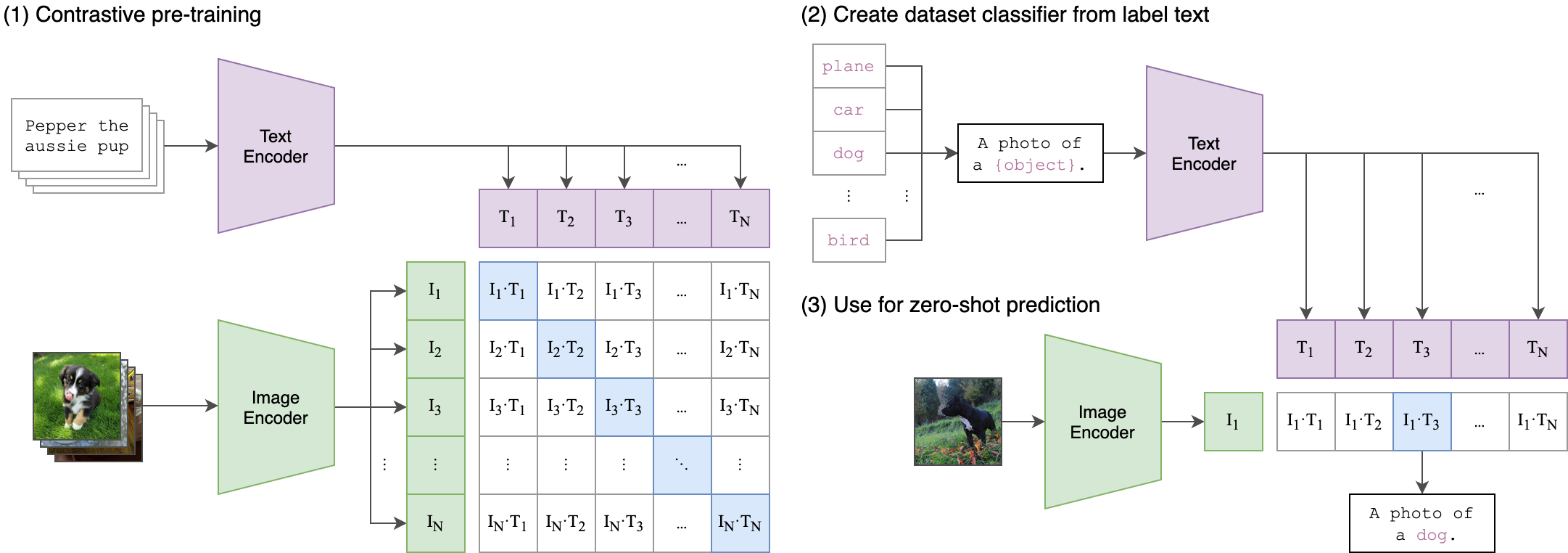
Summary: On January 5, 2021, OpenAI introduced CLIP, a groundbreaking software innovation that taught machines to understand the relationship between visual imagery and written language by mapping both into a unified, shared mathematical space.
OpenAI's release of CLIP (Contrastive Language-Image Pre-training) on January 5, 2021, in San Francisco, marked a pivotal moment in machine perception. By training a model on hundreds of millions of image-text pairs from the internet, the software learned to associate visual concepts with their descriptive linguistic labels. This removed the need for traditional, labor-intensive categorization, allowing a computer to recognize objects it had never explicitly been taught to identify—a capability known as zero-shot learning. It transformed how machines interpret the world, shifting the focus from static labeling to a dynamic, fluid understanding of context.
| Historical Attribute | Milestone Registry Value |
|---|---|
| Classification Type | software |
| Chronological Date | 2021-01-05 |
| Coordinates / Location | San Francisco, California |
| Curation Authority | Nick Hodder + MIA |
| Milestone Importance | godfather Milestone |
How does CLIP Visual Alignment fit into the history of artificial intelligence?
The lineage of CLIP Visual Alignment can be traced back to the early attempts at pattern recognition and neural simulation, such as the SNARC Neural Simulator and The Perceptron. While early researchers focused on simple classifications, such as identifying basic shapes or digits, the field eventually moved toward massive, data-driven approaches exemplified by ImageNet Database Project and the subsequent rise of AlexNet Convolutional Net.
Before CLIP, systems were largely siloed; a model trained to identify cats could not inherently understand a sentence describing a cat. The evolution through Word2Vec Representation and the architectural revolution of The Transformer Paper allowed researchers to bridge these modalities. By the time of the Vision Transformer (ViT), the stage was set for a multi-modal synthesis. CLIP successfully synthesized these histories, acting as a crucial bridge between language models like GPT-3 Language Model and visual perception systems.
What are the core technical achievements of CLIP Visual Alignment?
The core technical achievement of CLIP is contrastive learning. Rather than predicting exact pixel values or specific categorical labels, the model learns to maximize the similarity between an image and its corresponding text caption in a high-dimensional vector space, while minimizing the distance to unrelated pairings. This approach allows the system to build a robust internal representation of concepts.
Quantitatively, CLIP demonstrated remarkable versatility. In zero-shot classification tests, it achieved accuracy levels rivaling fully supervised models trained specifically for those datasets without having ever seen a single training example from them. By leveraging a massive dataset of 400 million image-text pairs, the model internalized a broad, "common sense" understanding of visual scenes. This stood in stark contrast to the brittle nature of previous expert systems like DENDRAL Expert System or MYCIN Expert System, which relied on handcrafted rules. CLIP’s ability to generalize to new, unseen categories provided a foundational shift in how neural networks are architected.
Why is the legacy of CLIP Visual Alignment significant to modern computing?
The legacy of CLIP is most prominently found in its role as the semantic "anchor" for modern generative models. By providing a reliable way to map language to visual space, it enabled the rise of text-to-image synthesis seen in subsequent systems like DALL-E Visual Generator and Stable Diffusion Model. These diffusion processes rely on the guidance provided by the CLIP vector space to ensure that the generated output corresponds faithfully to the user's textual prompt.
Beyond generation, CLIP redefined the efficiency of classification. It effectively ended the era where each specific computer vision task required its own unique, manually labeled dataset. As software developers and researchers moved toward GPT-4 Multimodal Model and later iterations, the fundamental logic of cross-modal alignment became the standard. This achievement solidified the transition from narrow AI—specialized for specific, limited domains—toward more general-purpose, multimodal systems capable of interpreting diverse information streams, fundamentally altering the trajectory of software engineering for the next decade.