AlphaFold 1 Protein Predictor
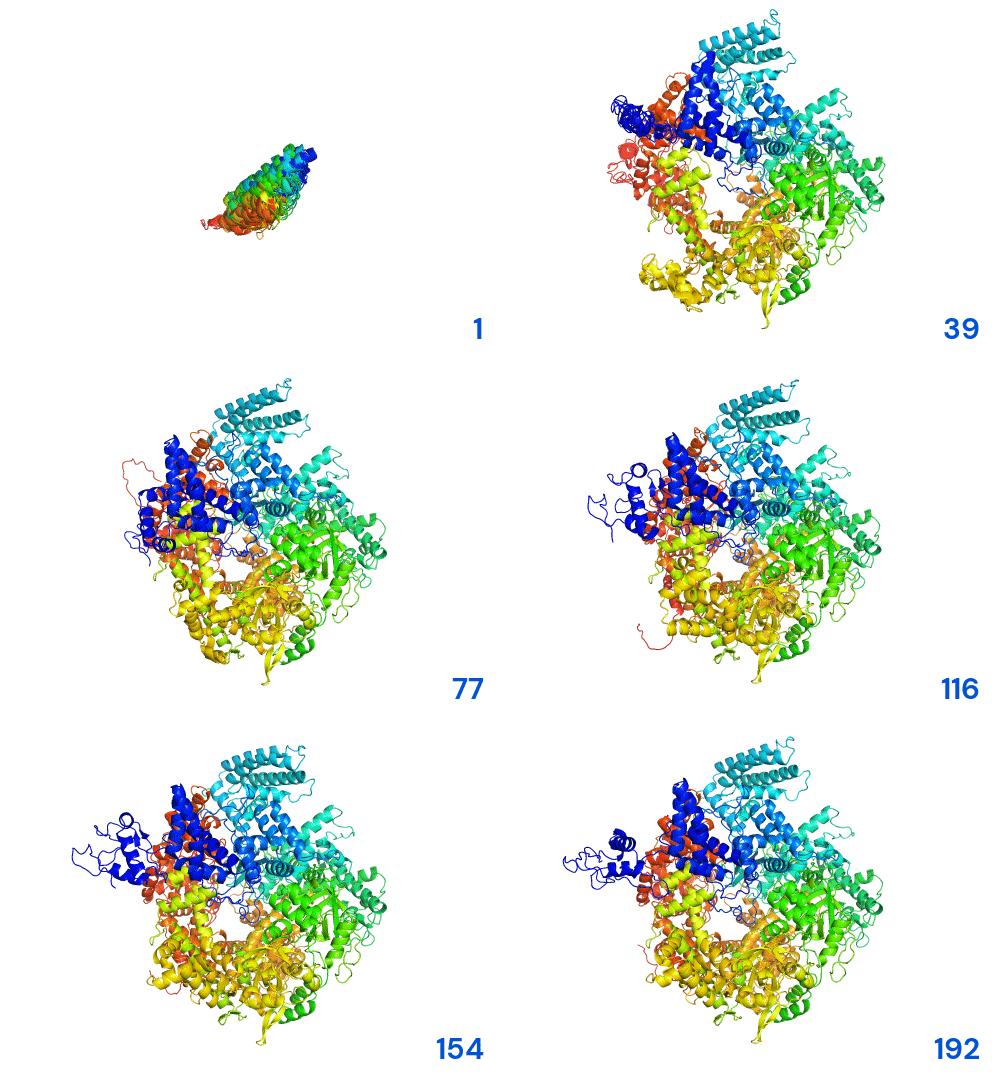
Summary: Unveiled by Google DeepMind on December 2, 2018, the AlphaFold 1 software marked a transformative moment in structural biology by leveraging deep learning to predict the intricate 3D shapes of proteins with unprecedented precision.
On December 2, 2018, in London, a team of researchers at Google DeepMind introduced the world to a new way of solving one of biology's oldest and most difficult challenges. Proteins are tiny, complex machines within our bodies that act like the gears and levers of life, but their function is entirely determined by how they fold into 3D shapes. For decades, scientists struggled to predict these shapes using computers. AlphaFold 1 arrived as a software breakthrough that used artificial intelligence to "guess" these shapes based on patterns in genetic data, successfully winning the prestigious CASP13 competition and proving that machines could outperform traditional methods in understanding the physical architecture of living systems.
| Historical Attribute | Milestone Registry Value |
|---|---|
| Classification Type | software |
| Chronological Date | 2018-12-02 |
| Coordinates / Location | London, UK |
| Curation Authority | Nick Hodder + MIA |
| Milestone Importance | standard Milestone |
How does AlphaFold 1 Protein Predictor fit into the history of artificial intelligence?
The development of AlphaFold 1 sits at the intersection of long-standing computational traditions and modern neural architectures. While early pioneers like Alan Turing conceptualized machines capable of logical reasoning, and researchers such as those involved in the Dartmouth Workshop established the field of AI, the transition to deep learning required decades of refinement in neural networks. From the early McCulloch-Pitts Neural Model and The Perceptron to the later Backpropagation Popularized era, the field evolved toward high-capacity pattern recognition. AlphaFold 1 represents a modern synthesis of this history, utilizing advanced optimization techniques similar to those found in TensorFlow Platform and PyTorch Framework to address complex, non-game-based domains, effectively extending the computational success of AlphaGo vs Lee Sedol into the realm of physical science.
What are the core technical achievements of AlphaFold 1 Protein Predictor?
AlphaFold 1’s success was rooted in its ability to predict the physical distances between pairs of amino acids and the angles of chemical bonds within a protein chain. By analyzing massive databases of known protein sequences and their corresponding 3D structures, the system employed deep convolutional neural networks—descendants of the architecture pioneered by the LeNet-5 Convolutional Net—to learn the evolutionary rules of protein folding. During the CASP13 competition, the software achieved a Global Distance Test (GDT) score of nearly 60, significantly outperforming competitors that relied on traditional template-based modeling. It moved beyond simple comparison; it synthesized new spatial information by identifying hidden co-evolutionary patterns in amino acid sequences. This was supported by massive compute resources, reflecting the scale of infrastructure seen in the TPU v3 Pod clusters of the era.
Why is the legacy of AlphaFold 1 Protein Predictor significant to modern computing?
The legacy of AlphaFold 1 is that it fundamentally shifted the expectation of what AI could achieve in the natural sciences. Before its arrival, computational biology was often considered a slow, iterative process of human-guided trial and error. AlphaFold 1 demonstrated that, given sufficient data and modern GPU-accelerated architectures—similar to the power provided by the NVIDIA H100 GPU in later years—a software agent could solve an "NP-hard" problem that had baffled human experts for 50 years. This milestone paved the way for subsequent iterations, leading directly to the even more accurate AlphaFold 2 Biological Model and the later AlphaFold 3 Predictor. It established a standard of "AI-driven discovery," proving that software can act not just as a tool for calculation, but as an active participant in scientific research, shortening the time required for drug discovery and disease modeling from years to mere days.