LeNet-5 Convolutional Net
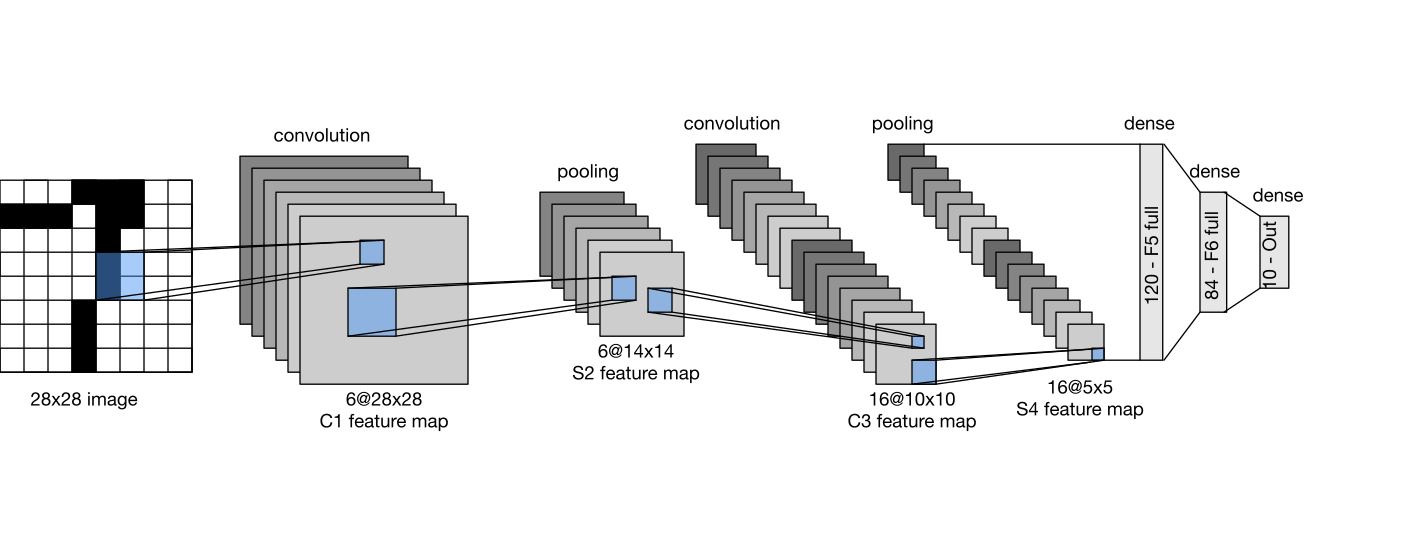
Summary: On November 1, 1998, a team of pioneering researchers codified the modern era of computer vision by publishing the LeNet-5 architecture, a groundbreaking software model that demonstrated how machines could effectively "see" and recognize handwritten characters by learning hierarchical features from raw data.
In the autumn of 1998, in Red Bank, New Jersey, researchers Yann LeCun, Léon Bottou, Yoshua Bengio, and Patrick Haffner released the formal architecture for LeNet-5. This software milestone transformed how computers process images by introducing a structured, multi-layer approach to pattern recognition. Before this, machines struggled to interpret the messy, variable reality of human handwriting. LeNet-5 solved this by breaking images down into simple components, effectively teaching a computer to identify curves and lines before combining them into full characters, a process that mirrors how human eyes translate light into understanding.
| Historical Attribute | Milestone Registry Value |
|---|---|
| Classification Type | software |
| Chronological Date | 1998-11-01 |
| Coordinates / Location | Red Bank, New Jersey |
| Curation Authority | Nick Hodder + MIA |
| Milestone Importance | godfather Milestone |
How does LeNet-5 Convolutional Net fit into the history of artificial intelligence?
The development of LeNet-5 represents the maturation of neural network research that began decades earlier with the McCulloch-Pitts Neural Model and the subsequent The Perceptron. While early attempts at machine intelligence often stalled due to limited computational power and lack of data, the late 20th century saw a resurgence in interest. LeNet-5 followed the foundational work of the The Neocognitron, which first proposed the concept of biological-inspired hierarchical visual processing. By refining Backpropagation Popularized, LeCun and his colleagues were able to train deeper, more efficient networks, directly building upon the early LeNet Digit Classifier to create a robust, industry-standard tool for document recognition.
What are the core technical achievements of LeNet-5 Convolutional Net?
LeNet-5 is defined by its use of three primary layers: convolutional, pooling, and fully connected. Convolutional layers act as local feature extractors; they slide small filters across an image to identify specific visual features like horizontal or vertical edges. The pooling layer then reduces the complexity of this information, allowing the system to focus on the most important aspects of the image regardless of their exact position. Finally, the fully connected layers use this condensed data to make a final classification. In testing, this architecture achieved an error rate of less than 1% on the MNIST database, a standard set of 60,000 handwritten digits. This was a significant improvement over the performance of systems existing in the early 1990s, proving that gradient-based learning could outperform manual, rule-based feature engineering.
Why is the legacy of LeNet-5 significant to modern computing?
The legacy of LeNet-5 is effectively the blueprint for the current revolution in deep learning. By formalizing the building blocks of convolutional neural networks (CNNs), the researchers provided a path forward for scaling software systems to handle massive amounts of visual data. This work laid the groundwork for GPU-Accelerated CNNs and eventually the massive architectures seen in AlexNet Convolutional Net. The principles established in 1998 are now embedded in virtually every modern object detection and image recognition system in existence. Even in the era of GPT-4 Multimodal Model and Vision Transformer (ViT), the fundamental insight—that networks can learn spatial hierarchies of features directly from raw pixels—remains the bedrock of artificial visual intelligence.