AlphaFold 2 Biological Model
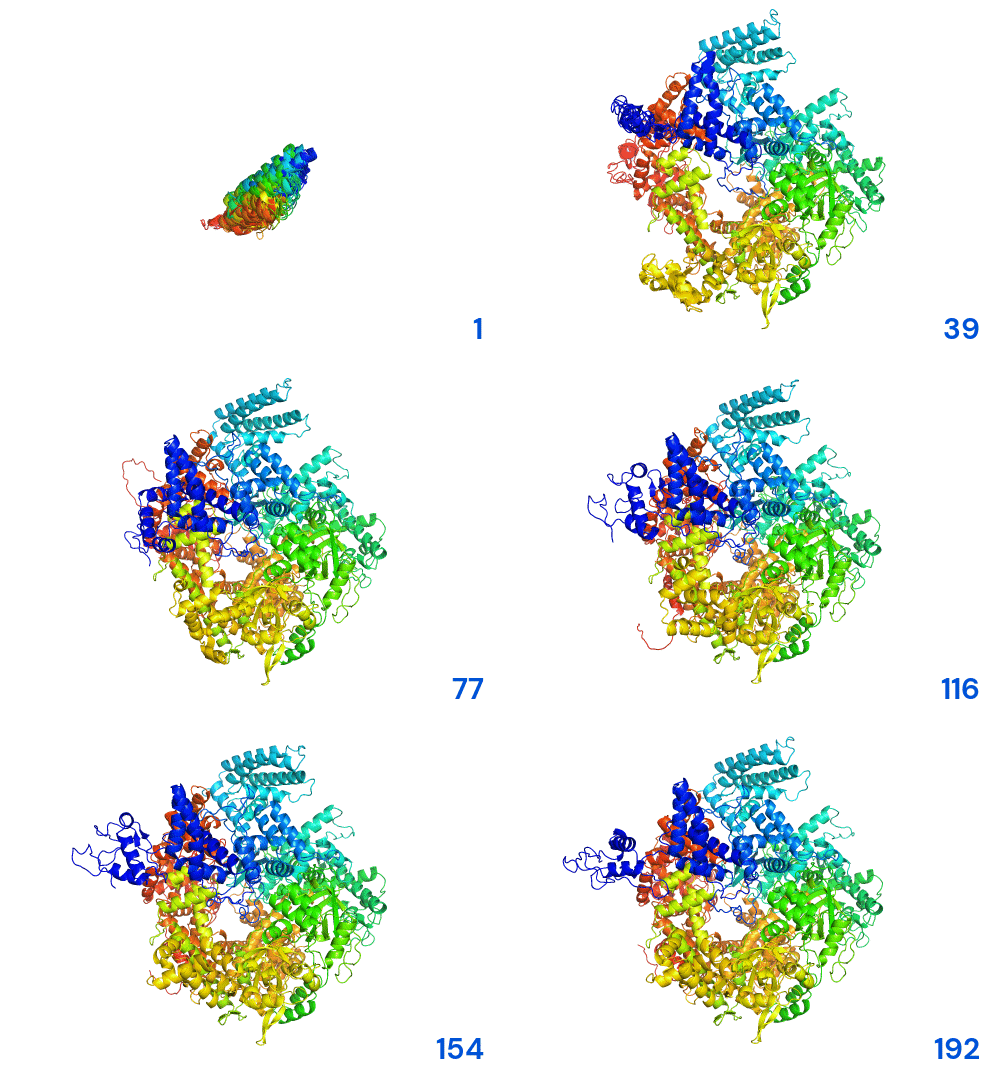
Summary: On November 30, 2020, Google DeepMind unveiled AlphaFold 2, a revolutionary software system that solved the "protein folding problem," a formidable challenge in molecular biology that had stumped researchers for over half a century.
In the landscape of scientific discovery, the structure of a protein—the tiny, complex machines inside every living cell—determines its function. For 50 years, understanding how a one-dimensional chain of amino acids twists and coils into a functional three-dimensional shape was a grand challenge of biology. On November 30, 2020, in London, Google DeepMind announced that their software, AlphaFold 2, had achieved near-experimental accuracy at the CASP14 competition, effectively solving this problem by predicting the precise shapes of proteins using advanced artificial intelligence.
| Historical Attribute | Milestone Registry Value |
|---|---|
| Classification Type | software |
| Chronological Date | 2020-11-30 |
| Coordinates / Location | London, UK |
| Curation Authority | Nick Hodder + MIA |
| Milestone Importance | godfather Milestone |
How does AlphaFold 2 Biological Model fit into the history of artificial intelligence?
The evolution of computation began with theoretical foundations laid by Alan Turing and was expanded by the McCulloch-Pitts Neural Model. For decades, researchers moved from simple neural simulators like SNARC Neural Simulator to complex systems like Deep Blue Chess Machine and AlphaGo vs Lee Sedol. AlphaFold 2 represents a shift from mastering games to solving fundamental physical sciences. While earlier milestones focused on symbolic logic like Logic Theorist or early expert systems like DENDRAL Expert System, AlphaFold 2 utilized the deep learning revolution, building upon architectures like the The Transformer Paper. It demonstrates how machine learning has transitioned from a specialized tool for pattern recognition into an engine for scientific discovery.
What are the core technical achievements of AlphaFold 2 Biological Model?
AlphaFold 2 achieved its breakthrough by moving away from traditional physical simulation toward a geometric deep learning approach. The system was trained on the Protein Data Bank, an archive containing over 170,000 known protein structures. By using an "evoformer" block, the model processed evolutionary information from protein sequences alongside spatial constraints. In the CASP14 assessment, it achieved a median Global Distance Test (GDT) score of 92.4, a metric ranging from 0 to 100 that measures structural accuracy. This score is comparable to results obtained via experimental methods like X-ray crystallography, which can take months of laboratory work to produce. The model functions by iteratively refining the spatial coordinates of atoms, effectively learning the complex, non-linear physical interactions that cause a protein to fold into its lowest-energy, most stable state.
Why is the legacy of AlphaFold 2 significant to modern computing?
The impact of this milestone extends far beyond the software itself. It essentially provided a roadmap for utilizing AI to solve "black box" problems in the natural world. By open-sourcing the tool and its predictions, the research has accelerated progress in drug discovery, environmental sustainability, and synthetic biology. The success of AlphaFold 2 paved the way for subsequent iterations, such as AlphaFold 3 Predictor, which now models interactions between proteins and other biological molecules like DNA and RNA. It has solidified the role of high-performance computing—leveraging systems such as the TPU v4 Supercluster—as an essential partner to the wet lab. In the broader scope of AI history, AlphaFold 2 stands as proof that algorithmic systems can decode the physical building blocks of life, fundamentally altering the trajectory of biotechnology in the 21st century.