Walter Pitts
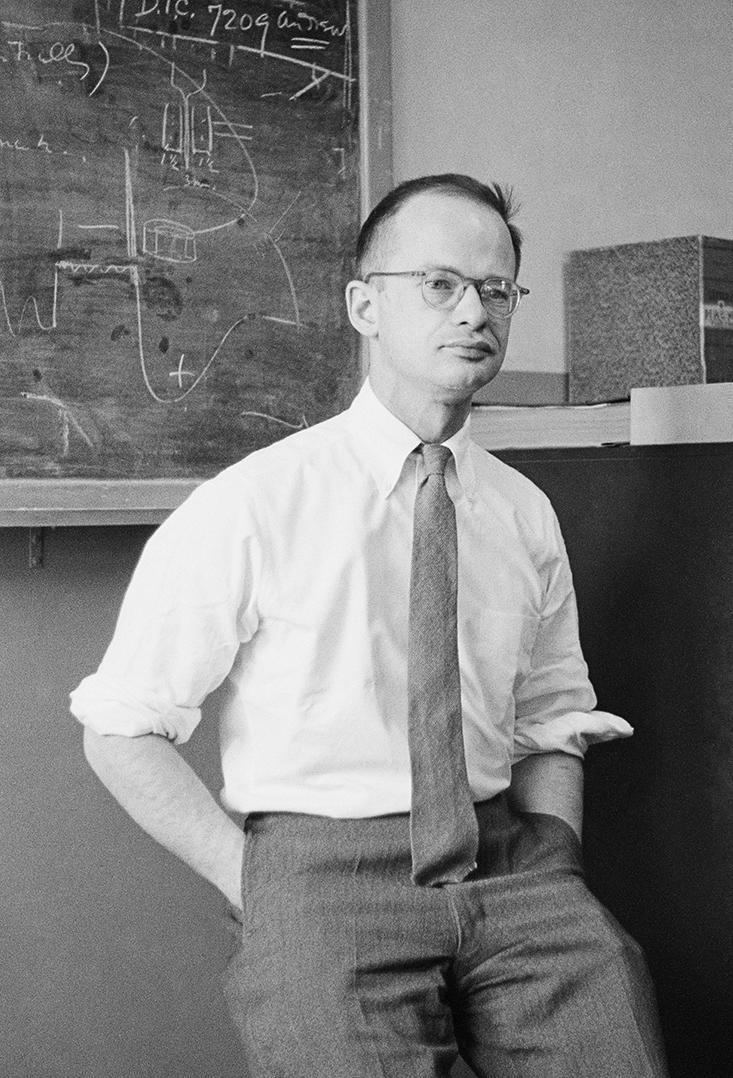
Summary: Walter Pitts, a brilliant, self-taught mathematical prodigy, forever altered the course of cognitive science on December 1, 1943, by mathematically demonstrating that neural structures could function as logical processing gates.
On December 1, 1943, in Chicago, Illinois, the field of artificial intelligence received its theoretical foundation through the work of Walter Pitts. By bridging the gap between biological brain function and mathematical logic, he enabled the conceptualization of machines that could "think" or reason. His work effectively argued that the brain's neurons, which either fire or remain silent, could be modeled as simple on-off switches capable of performing complex computations. This moment served as the starting point for the development of digital logic within computing, turning the abstract idea of a "thinking machine" into a concrete, solvable engineering problem.
| Historical Attribute | Milestone Registry Value |
|---|---|
| Classification Type | person |
| Chronological Date | 1943-12-01 |
| Coordinates / Location | Chicago, Illinois |
| Curation Authority | Nick Hodder + MIA |
| Milestone Importance | standard Milestone |
How does Walter Pitts fit into the history of artificial intelligence?
The entry of Walter Pitts into the annals of history represents the synthesis of neurology and symbolic logic. In the early 1940s, the scientific community struggled to understand how a biological organ—the human brain—could produce complex logic. Alongside Warren McCulloch, Pitts published the landmark McCulloch-Pitts Neural Model. This paper was the first to propose that individual neurons were not just chemical conduits, but computational nodes. By proving that a network of these nodes could compute any logical function, he bridged the gap between Alan Turing's theoretical machine and the biological reality of the nervous system. This contribution was so profound that it set the stage for later developments, including Cybernetics Published and the eventual rise of neural network research.
What are the core technical achievements of Walter Pitts?
The primary achievement of Walter Pitts was the formal proof that networks of threshold units are capable of executing any logical proposition. This was a radical departure from the prevailing biological theories of the time. Pitts defined a mathematical framework where neurons receive inputs, aggregate them, and, upon reaching a specific threshold, output a binary signal—1 or 0. This allowed researchers to represent complex thoughts or decisions as combinations of "AND," "OR," and "NOT" logic gates. By 1943, he demonstrated that these networks could theoretically perform the same functions as the electronic hardware being envisioned in projects like the Colossus Computer. This was not merely an abstract thought; it provided a blueprint for how hardware might emulate cognitive behavior, a principle later utilized in the SNARC Neural Simulator.
Why is the legacy of Walter Pitts significant to modern computing?
The legacy of Walter Pitts is the cornerstone of modern connectionism. While the logic-based approach of the Logic Theorist dominated the 1950s, the eventual shift toward deep learning has brought the focus back to the foundational principles Pitts established. Modern architectures, from the simplest The Perceptron to the massive, multi-layer systems that power modern artificial intelligence, are direct descendants of his 1943 research. Every time a contemporary model uses a sigmoid or ReLU activation function to trigger a signal, it is executing a refined, high-speed digital version of the "all-or-nothing" threshold mechanism Pitts first described. His mathematical rigor allowed the field to progress through various AI Winter 1 and AI Winter 2 cycles, eventually enabling the success of Backpropagation Popularized and the subsequent explosion in computational intelligence. By providing a common language between the biological brain and the silicon circuit, Pitts remains one of the most vital figures in the transition from mechanical calculation to machine intelligence.