Unimate Industrial Robot
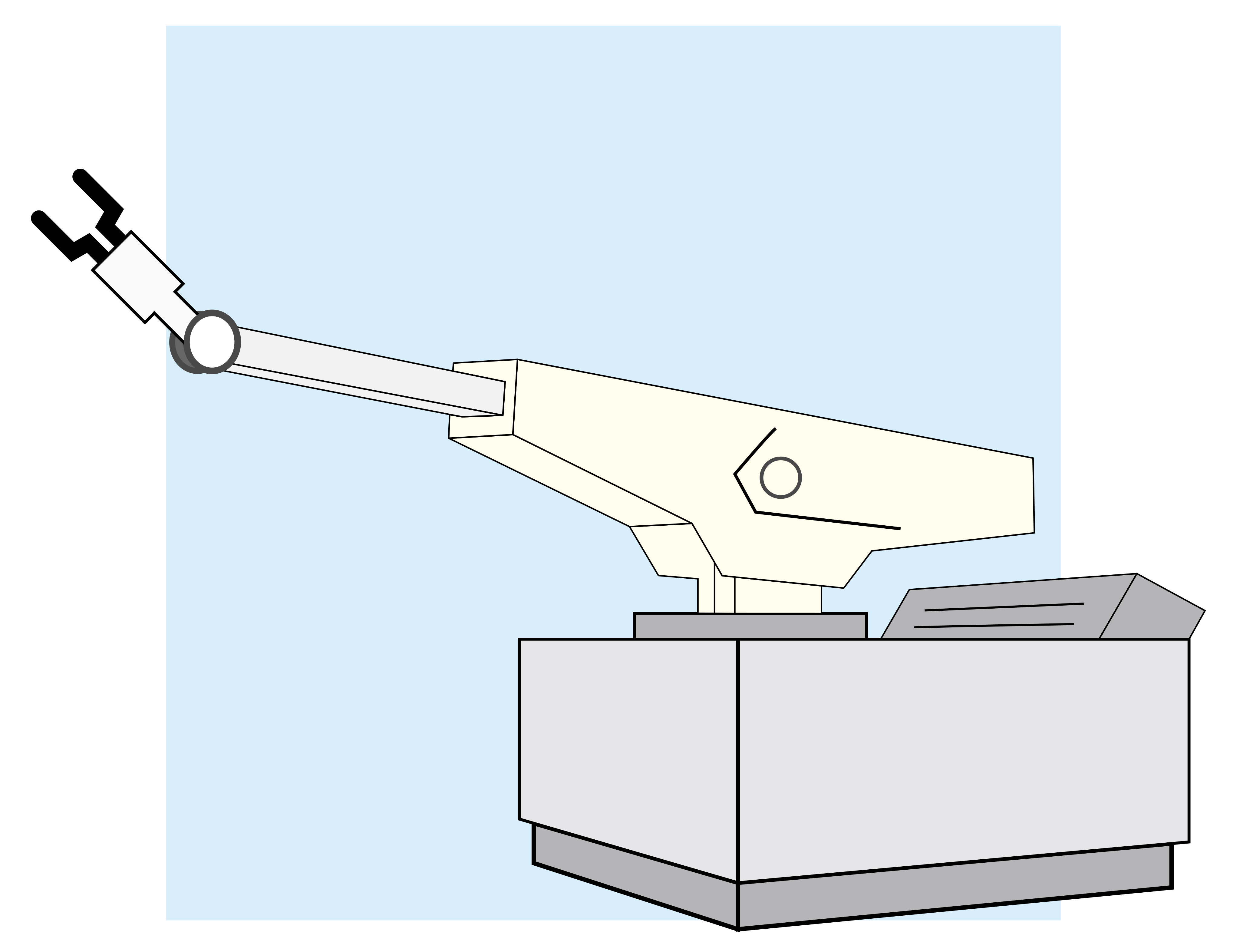
Summary: On April 1, 1961, the Unimate—the world's first industrial robot—was deployed on a General Motors assembly line in Ewing, New Jersey, forever changing the landscape of manufacturing by proving that programmable mechanical arms could safely and efficiently perform hazardous, repetitive human labor.
In the spring of 1961, history was quietly made at the General Motors Ternstedt plant in Ewing, New Jersey. A massive, 2,700-pound mechanical arm known as the Unimate was bolted to the factory floor. Before this milestone, machines were designed to perform only one specific, rigid task forever. The Unimate introduced the revolutionary concept of programmability to the physical world: it was a metallic arm that could be "taught" different movement patterns to perform various chores, much like how a cassette tape records different songs. By taking over the dangerous task of handling red-hot metal parts, this single machine proved that human workers could step back from extreme physical hazards and instead manage intelligent machines that did the heavy lifting.
| Historical Attribute | Milestone Registry Value |
|---|---|
| Classification Type | machine |
| Chronological Date | 1961-04-01 |
| Coordinates / Location | Ewing, New Jersey |
| Curation Authority | Nick Hodder + MIA |
| Milestone Importance | standard Milestone |
How does Unimate Industrial Robot fit into the history of artificial intelligence?
While early artificial intelligence research of the 1950s focused primarily on symbolic logic, abstract problem-solving, and digital software, the Unimate represented the physical realization of "embodied intelligence." For decades, the public imagination had been captivated by literary and cinematic visions of artificial men, from Karel Čapek's seminal play R.U.R. (Rossum's Universal Robots) to the mechanical Maria in Fritz Lang's Metropolis Film. Authors had even begun codifying the ethical constraints of these machines, most notably in Isaac Asimov's Three Laws of Robotics published within his I, Robot Anthology. However, there remained a vast chasm between literary imagination and functional engineering.
The Unimate bridged this chasm by translating the theoretical control principles of Norbert Wiener's Cybernetics Published into industrial hardware. While contemporary computer scientists were developing digital reasoning programs on mainframe computers, the Unimate's inventors, George Devol and Joseph Engelberger, realized that intelligence could also be defined as the precise, goal-oriented manipulation of the physical environment.
By establishing a reliable link between digital memory storage and physical actuation, the Unimate laid the groundwork for the field of physical robotics. It proved that a machine could autonomously execute complex sequences of motor controls without direct real-time human intervention. This shift from static automation to programmable machinery was a necessary historical stepping stone toward later, more cognitive mobile agents, such as the Stanford Cart and the self-navigating Shakey the Robot, which would eventually combine physical mobility with high-level computerized decision-making.
What are the core technical achievements of Unimate Industrial Robot?
The design of the Unimate was based on George Devol’s 1954 patent for a "Programmed Article Transfer" device. Devol’s breakthrough concept was the integration of a digital memory buffer with hydraulic servo-mechanisms. The machine itself consisted of a massive, box-like base housing a cantilevered, telescoping arm equipped with a customizable end-effector, or gripper. Operating with five degrees of freedom, the hydraulic arm was capable of lifting and moving payloads weighing up to 500 pounds (approx. 225 kg) with a high degree of spatial accuracy, repeating its taught paths within a tolerance of 0.05 inches (1.27 mm).
The core of the Unimate's intelligence was its unique, state-of-the-art "magnetic drum memory" system. At a time when magnetic disk storage was in its infancy, Devol and Engelberger engineered a rotating magnetic drum that could store up to 200 sequential coordinate commands. To program the robot, a human operator used a wired teaching pendant—a handheld controller—to manually drive the arm to specific coordinates in space. When the operator clicked a button, the physical position of the arm's joints was converted by shaft encoders into digital binary code, which was then written as magnetic marks on the rotating drum.
When switched to "run" mode, the Unimate functioned as a closed-loop control system. It read the recorded joint positions from the magnetic drum, compared those target positions to the real-time feedback from its joint encoders, and regulated hydraulic valves to drive the cylinders to the exact coordinates specified.
At the General Motors Ternstedt plant in Ewing, New Jersey, this technical capability was put to a grueling test. The Unimate's job was to extract glowing, red-hot die-cast door handles and other automotive parts from casting molds, quench them in cooling liquid, and place them on a conveyor belt. This task was notorious for causing severe burns, respiratory issues from toxic fumes, and crushing accidents among human workers. The Unimate performed this sequence flawlessly, operating 24 hours a day in an environment that was deeply hostile to organic life.
Why is the legacy of Unimate Industrial Robot significant to modern computing?
The installation of the Unimate initiated the modern age of industrial automation and shaped the trajectory of subsequent robotic development. Following its success at General Motors, Devol and Engelberger founded Unimation, the world's first commercial robotics company. By the late 1960s and early 1970s, manufacturing facilities worldwide—most notably in Japan, where companies eagerly licensed Unimation's technology—had begun installing thousands of robotic manipulators, permanently restructuring the global manufacturing economy.
From a computational perspective, the Unimate initiated the study of spatial coordinate systems, kinematics, and trajectory planning that remains central to modern robotics. The engineering lessons learned from the Unimate directly informed the evolution of lightweight, multi-jointed articulated arms, eventually leading to consumer applications like the Roomba Consumer Robot, human-interactive systems like the ASIMO Robot, and emotionally responsive research platforms like the Kismet Robot.
The architecture of the Unimate also set off a profound philosophical debate regarding the relationship between software and hardware. In the late 1980s, researchers like Rodney Brooks would critique the traditional, top-down cognitive models of AI, proposing a decentralized, behavior-based approach known as the Subsumption Architecture. This paradigm shift was inspired by the direct, reactive feedback loops that machines like the Unimate first utilized to navigate physical realities. Today, the lineage of this physical feedback control loop can be traced to advanced quadrupedal and humanoid platforms, such as the Boston Dynamics Spot and the highly agile Boston Dynamics Atlas, which rely on tight integration between digital computation, visual perception, and hydraulic or electric actuation.
Ultimately, the Unimate demonstrated that digital code could command physical force with precision and safety. It shifted the discourse of automation from a science-fiction trope into an objective economic reality, forever changing the human relationship with manual labor and proving that mechanical hardware could be governed by the flexible, programmable logic of digital computing.