Pandemonium Architecture
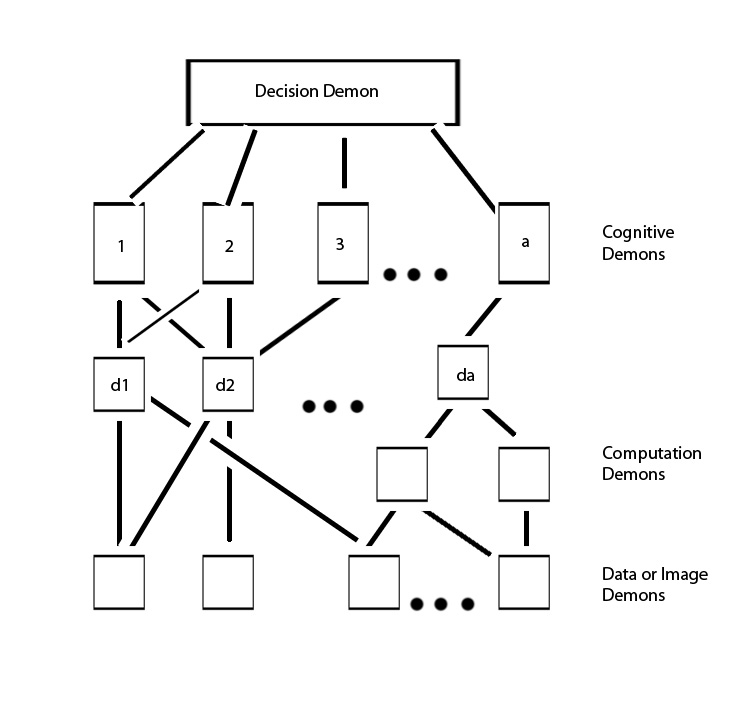
Summary: On May 1, 1959, computer scientist Oliver Selfridge published his seminal paper on the "Pandemonium" architecture, a revolutionary model for pattern recognition that organized decentralized, parallel sub-agents called "demons" into hierarchical layers to analyze visual data, serving as a vital conceptual precursor to modern multi-layer neural networks.
Imagine trying to identify a mystery letter written on a blackboard. Instead of one giant brain doing all the work, imagine a room filled with dozens of tiny, specialized helpers. One helper only looks for vertical lines, another looks for horizontal lines, and a third looks for circles. When these helpers spot their favorite shape, they start yelling out. Higher-level helpers listen to these shouts; for instance, a helper representing the letter "A" listens to the line-watchers, while the helper for the letter "O" listens to the circle-watcher. Finally, a single coordinator at the top selects the loudest group's guess. This is the "Pandemonium" architecture, introduced on May 1, 1959, in Lexington, Massachusetts, by computer scientist Oliver Selfridge. This simple, parallel, and layered model proved that machines could recognize complex patterns not through rigid, top-down programming, but through cooperative, bottom-up systems.
| Historical Attribute | Milestone Registry Value |
|---|---|
| Classification Type | software |
| Chronological Date | 1959-05-01 |
| Coordinates / Location | Lexington, Massachusetts |
| Curation Authority | Nick Hodder + MIA |
| Milestone Importance | standard Milestone |
How does Pandemonium Architecture fit into the history of artificial intelligence?
In the late 1950s, the nascent field of artificial intelligence was deeply divided over how to model cognition. Following the landmark Dartmouth Workshop in 1956—which Oliver Selfridge attended alongside figures like John McCarthy and Marvin Minsky—mainstream research leaned heavily toward symbolic logic and top-down heuristic search. This approach was exemplified by systems like the Logic Theorist. However, a parallel, biologically-inspired movement sought to construct bottom-up, adaptive systems modeled on the human nervous system, building on the earlier McCulloch-Pitts Neural Model and the cybernetic theories of Norbert Wiener.
Selfridge, working at the MIT Lincoln Laboratory in Lexington, Massachusetts, sought a practical computational method to solve visual pattern recognition, specifically targeting Morse code translation and hand-printed character recognition. Published in the proceedings of the 1958 Symposium on the Mechanisation of Thought Processes, his "Pandemonium" paper formalized a compromise. It acknowledged the value of functional abstraction but implemented it through a completely decentralized, parallel network of simple computational nodes. This conceptual leap directly complemented Frank Rosenblatt's work on The Perceptron, pushing AI toward the connectionist paradigm that would eventually dominate the 21st century.
What are the core technical achievements of Pandemonium Architecture?
The technical brilliance of Pandemonium lies in its structured, multi-tiered hierarchy of four distinct classes of "demons" (sub-agents), which process information sequentially and in parallel:
1. Data Demons: These agents do not process information; they merely receive and store the raw, digitized sensory input (such as a 2D grid of pixels representing an image) and pass it along to the next layer.
2. Computational Demons: Operating in parallel, these feature-extraction agents analyze the raw data for specific, localized primitives. Each computational demon is programmed to detect one distinct attribute, such as horizontal lines, acute angles, or specific curvature values. They output a analog value indicating the confidence or strength of their detection.
3. Cognitive Demons: These agents represent the classification hypotheses (e.g., the letters "A", "B", "C"). Each cognitive demon listens to the outputs of the computational demons, applying specific weights to their inputs. For instance, the cognitive demon for "A" will weight inputs from vertical-slant and horizontal-bar detectors highly. The strength of their "shout" corresponds to the mathematical summation of these weighted inputs.
4. Decision Demon: At the apex of the hierarchy sits a single arbitrator. It scans the cognitive layer, identifies the demon shouting with the highest intensity, and outputs that selected category as the system's official recognition decision.
Beyond this structural layout, Selfridge proposed a mechanism for learning and self-organization. He realized that the weights of the connections between the computational and cognitive layers could be adjusted adaptively based on error feedback. Additionally, he suggested that the system could evolve by pruning inactive computational demons and "mutating" successful ones to look for slightly different feature combinations—conceptualizing a process that heavily anticipated the later formalization of Genetic Algorithms Defined.
Why is the legacy of Pandemonium Architecture significant to modern computing?
While early implementations of Pandemonium were constrained by the limited memory and processing power of vacuum tube and early transistorized computers, the architecture's theoretical impact was immense. By demonstrating that a cascade of simple, non-intelligent sub-units could produce highly intelligent emergent behavior, Selfridge laid the logical groundwork for hierarchical feature extraction. This architecture directly inspired Kunihiko Fukushima's The Neocognitron in 1980, which modeled biological vision with cascading layers of feature extractors, and Yann LeCun's pioneering LeNet Digit Classifier in 1989.
When single-layer networks were heavily criticized in the landmark 1969 Perceptrons Book Published, Pandemonium remained a theoretical beacon showing how multi-layer systems could overcome those limitations. Once mathematical formulations like Backpropagation Formulated were perfected to train multi-layer architectures, Selfridge's basic division of labor—raw input, feature detection, weighted integration, and final classification—became the undisputed standard for convolutional neural networks (CNNs) and deep learning models.
Furthermore, the "demon" metaphor influenced the development of multi-agent systems and software engineering. Marvin Minsky's *Society of Mind* framework drew heavily on Pandemonium, as did Rodney Brooks' reactive robotics research, which culminated in the Subsumption Architecture in 1987. From modern computer vision pipelines to localized software demons running in the background of operating systems today, the echoes of Selfridge's noisy, shouting agents remain fundamental to modern computational design.