ELIZA Chatbot
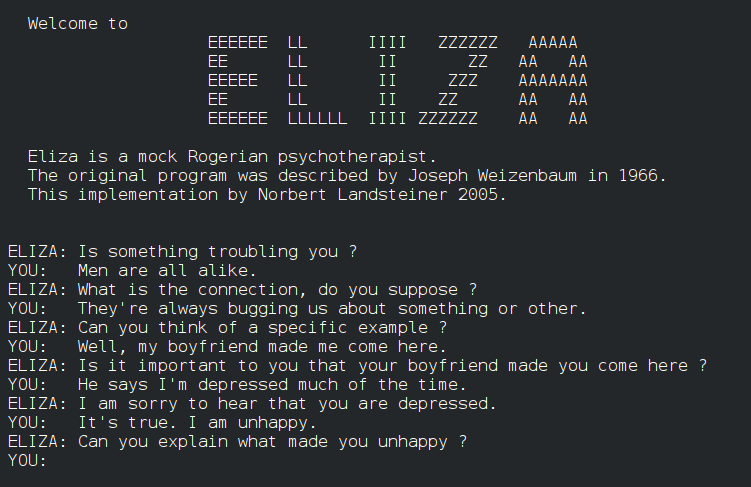
Summary: On January 15, 1964, German-American computer scientist Joseph Weizenbaum finalized ELIZA, a pioneering program at the Massachusetts Institute of Technology that became the world's first natural language processing chatbot. By mimicking the conversational style of a Rogerian psychotherapist, ELIZA demonstrated that remarkably simple pattern-matching rules could elicit profound emotional connections from human users, revealing a startling human vulnerability to perceived machine intelligence.
In January 1964, in Cambridge, Massachusetts, a computer scientist named Joseph Weizenbaum created ELIZA, the world’s first talking computer program. Instead of actually understanding language, ELIZA operated like a clever conversational mirror: it looked for key words in what a person typed and used them to construct a matching question, much like a therapist asking, "Why do you feel that way?" This simple trick completely surprised people, demonstrating that humans are incredibly eager to project deep feelings, thoughts, and lifelike intentions onto machines, even when those machines are just following basic, mechanical rules.
| Historical Attribute | Milestone Registry Value |
|---|---|
| Classification Type | software |
| Chronological Date | 1964-01-15 |
| Coordinates / Location | Cambridge, Massachusetts |
| Curation Authority | Nick Hodder + MIA |
| Milestone Importance | godfather Milestone |
How does ELIZA Chatbot fit into the history of artificial intelligence?
In the early 1960s, the field of artificial intelligence was dominated by the pursuit of formal logic, mathematical proof systems, and game-playing algorithms. Early successes like the Logic Theorist and the Samuel Checkers Program fueled a belief that human-level intelligence could be achieved by hard-coding deductive reasoning. However, communicating with these systems remained highly technical, relying on punch cards and abstract mathematical notation. When Alan Turing proposed the Turing Test Proposed in 1950, he identified conversational language as the ultimate frontier for demonstrating machine thought.
ELIZA represented a radical departure from the prevailing symbolic paradigms. Created within the vibrant time-sharing research ecosystem of MIT’s Project MAC, ELIZA was not designed to "think" or build complex internal databases of real-world knowledge, unlike contemporary semantic systems such as the SIR Question Answering program. Instead, Joseph Weizenbaum sought to explore the boundaries of communication by exploiting conversational contexts.
By programming ELIZA to run a script called DOCTOR, which assumed the persona of a Carl Rogers-style nondirective psychotherapist, Weizenbaum bypassed the need to feed the computer a vast encyclopedia of facts. In Rogerian therapy, the therapist's role is not to offer advice or share personal information, but to mirror the patient's own statements back to them. This clever context-setting meant that any lack of real-world understanding on ELIZA's part was perceived by users not as a computational failure, but as a deliberate therapeutic technique.
What are the core technical achievements of ELIZA Chatbot?
Technically, ELIZA was an elegant masterclass in list processing and pattern matching. Weizenbaum originally wrote the system in MAD-SLIP (Michigan Algorithm Decoder with Symmetric List Processor), an extension of Fortran that he had designed himself, before it was widely ported to the LISP Programming Language. The core of ELIZA was its ability to read an input line of text, scan it for specific keywords, and apply transformation rules to reorganize the user's input into an output sentence.
The system functioned through a series of deterministic steps. First, the program scanned the user's input string from left to right, searching for keywords defined in its active script. Each keyword was assigned a priority number to handle cases where multiple keywords appeared in a single sentence. For example, if a user typed, "I want my mother to love me," the system would identify "mother" as a higher-priority keyword than "want."
Once a keyword was selected, the program applied a specific decomposition rule associated with that keyword. This rule segmented the input string into variables. For instance, the input "You are very helpful" would be decomposed based on a template matching `(0 YOU ARE 0)`, where the zeroes represent variable lengths of text. The program then accessed a reassembly rule, which reconstructed the segments into a response, such as "What makes you think I am helpful?"
To maintain grammatical consistency, the system ran substitution rules, converting first-person pronouns into second-person counterparts (e.g., swapping "my" to "your" and "me" to "you"). If no keywords were recognized, ELIZA would fall back on non-committal prompts such as "Please go on" or "Does that trouble you?" It could also retrieve a saved phrase from a simple memory buffer to reference a topic the user had mentioned earlier. ELIZA proved that natural-sounding interactions did not require the deep structural parsing described in the Chomsky Hierarchy Formulated, but could instead be sustained through clever surface-level syntactic manipulation.
Why is the legacy of ELIZA Chatbot significant to modern computing?
ELIZA’s legacy is defined by a paradox: its creator designed it to expose the superficiality of human-machine communication, yet it ended up proving how easily humans can be convinced of a machine's inner life. This phenomenon—where people attribute deep understanding, empathy, and agency to computer programs with known, simplistic structures—became globally recognized as the "ELIZA Effect." Weizenbaum was famously horrified when his own secretary, who knew he had written the code, asked him to leave the room so she could have a private, intimate conversation with the program.
The intense emotional bonds users formed with ELIZA sparked a profound shift in Weizenbaum’s career. Witnessing psychiatrists suggest that the DOCTOR script could be scaled to automatically treat mental illness, he became one of the first and most vocal critics of artificial intelligence. In his seminal 1976 book, *Computer Power and Human Reason*, Weizenbaum argued that because computers lack genuine human empathy, understanding, and life experience, they should never be granted authority over human decisions or emotional care.
This early milestone laid the foundation for decades of philosophical and technical debates. ELIZA’s success served as a practical precursor to the Chinese Room Argument formulated by philosopher John Searle, which argues that symbol manipulation is fundamentally distinct from true semantic understanding. Decades after its creation, ELIZA remains a foundational benchmark in natural language processing, serving as a reminder that the human mind is always an active participant in creating the illusion of machine intelligence.