Terry Winograd
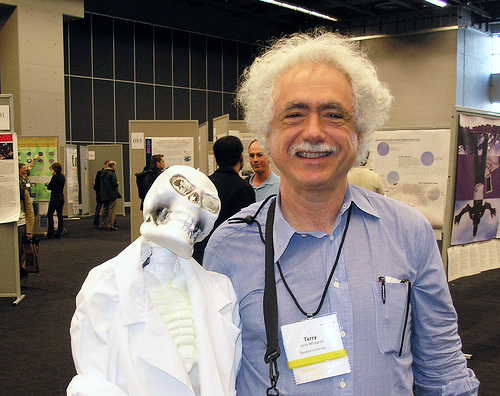
Summary: Terry Winograd, a pioneering computer scientist, forever altered the landscape of artificial intelligence on June 1, 1971, by unveiling SHRDLU, a groundbreaking program that demonstrated how machines could parse language by reasoning through a physical, virtual environment.
In the summer of 1971, at the Massachusetts Institute of Technology in Cambridge, Massachusetts, Terry Winograd completed a doctoral thesis that would become one of the most influential works in the history of computational linguistics. His program, SHRDLU, was designed to bridge the gap between human language and machine action. By creating a simulated world filled with simple objects like red cubes and blue pyramids, Winograd enabled a computer to "understand" and carry out commands issued in everyday English, such as "Pick up a red block." This milestone marked a departure from earlier, more superficial attempts at conversational software by introducing genuine reasoning and memory into the process of communication.
| Historical Attribute | Milestone Registry Value |
|---|---|
| Classification Type | person |
| Chronological Date | 1971-06-01 |
| Coordinates / Location | Cambridge, Massachusetts |
| Curation Authority | Nick Hodder + MIA |
| Milestone Importance | standard Milestone |
How does Terry Winograd fit into the history of artificial intelligence?
Terry Winograd emerged during a period of intense optimism regarding symbolic AI. Following the foundational work established by figures like John McCarthy and the theoretical frameworks of the Dartmouth Workshop, the field was seeking ways to make machines perform complex, human-like tasks. While early milestones like the ELIZA Chatbot utilized simple pattern matching to mimic conversation, Winograd sought to implement a deeper level of intelligence. By building on the Chomsky Hierarchy Formulated and the logic-based approaches seen in the General Problem Solver, Winograd proved that a computer could synthesize grammar, semantics, and real-world knowledge to navigate a specific domain. His work arrived just before the first AI Winter 1, providing a high-water mark for the symbolic paradigm that would be debated for decades.
What are the core technical achievements of Terry Winograd?
The primary achievement of SHRDLU was its integration of three distinct components: syntax, semantics, and a problem-solving engine. Technically, the system utilized a procedural grammar, which meant it interpreted linguistic rules as executable procedures. Unlike previous attempts that struggled with ambiguity, SHRDLU could track the state of the "blocks world" in real-time. If a user asked, "What is in the box?", the system would consult its internal model, verify the spatial arrangement, and formulate a reply. It could also resolve pronouns; if told "Pick up the red cube and put it on the green block," the program understood that "it" referred to the cube. This represented a shift from static data processing to dynamic, context-aware interaction, achieving a level of success that was considered revolutionary in 1971.
Why is the legacy of Terry Winograd significant to modern computing?
The legacy of Terry Winograd is inextricably linked to the tension between symbolic logic and connectionist approaches. While modern systems have transitioned toward statistical models and neural networks—often referenced alongside advancements like The Transformer Paper and BERT Language Model—the fundamental problem of "grounding" language in reality remains a cornerstone of the field. Winograd’s work highlighted that understanding language requires not just syntax, but a conceptual model of the world. This insight anticipated the necessity of multimodal learning, where AI must connect text to physical or visual representations. Furthermore, his shift from pure AI research to examining the social and political implications of technology, as evidenced by his later academic critiques, helped define the ethical responsibilities of those working in the field of artificial intelligence today.