PageRank Link Graph
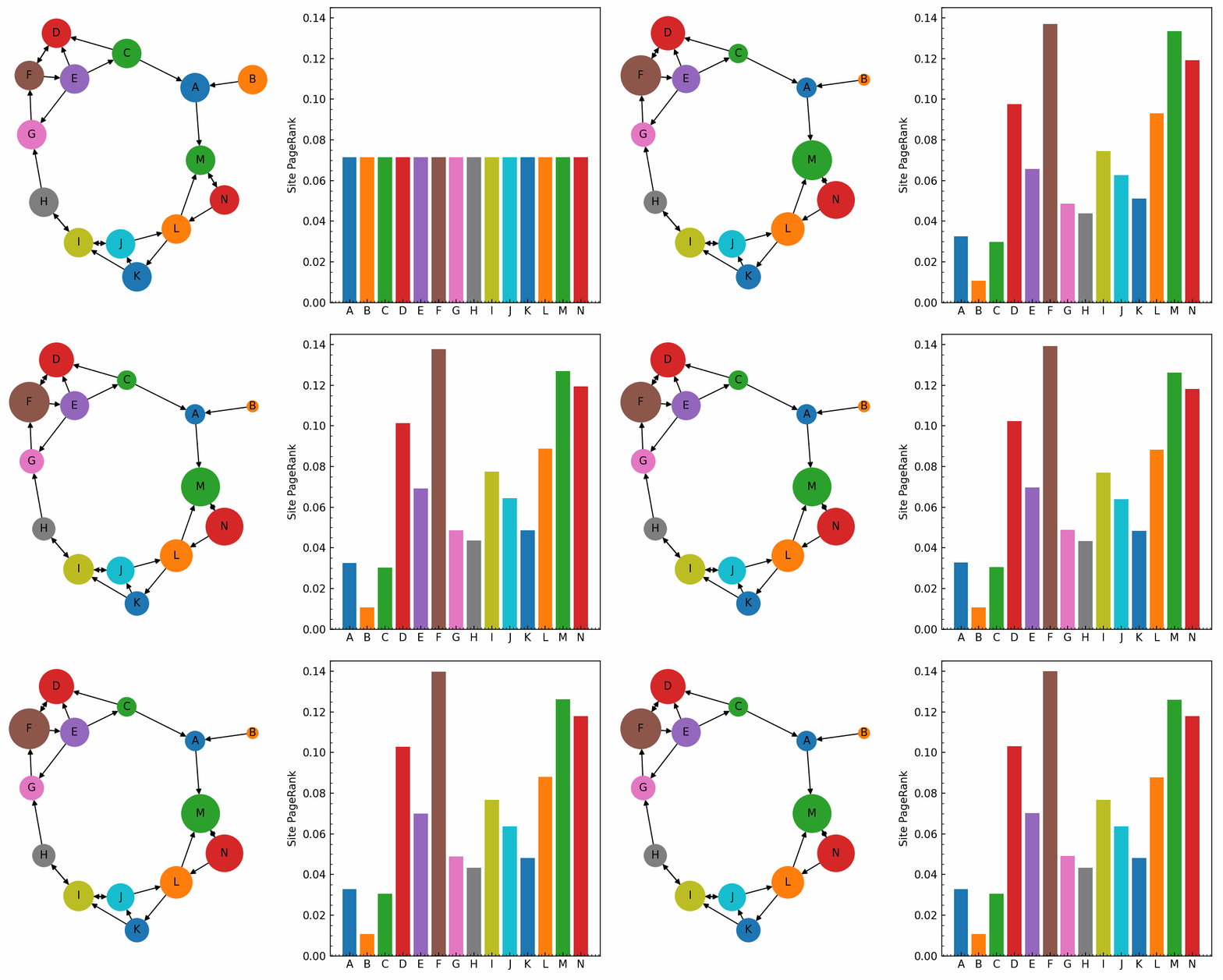
Summary: On September 1, 1997, researchers Larry Page and Sergey Brin formally introduced PageRank, a revolutionary software algorithm developed at Stanford University that transformed the chaotic expanse of the early web into an orderly, ranked index by evaluating the mathematical significance of hyperlinked connections.
In the mid-1990s, the internet was growing at an exponential rate, but finding specific information remained a manual and imprecise task. On September 1, 1997, at Stanford University, researchers Larry Page and Sergey Brin unveiled a system called PageRank. This software provided a breakthrough solution to the "information overload" problem by treating the web as a giant voting system, where every link from one page to another served as a vote of confidence. By calculating the importance of these pages based on the quality and quantity of their incoming links, the software allowed for a more intelligent and objective way to present search results.
| Historical Attribute | Milestone Registry Value |
|---|---|
| Classification Type | software |
| Chronological Date | 1997-09-01 |
| Coordinates / Location | Stanford, California |
| Curation Authority | Nick Hodder + MIA |
| Milestone Importance | standard Milestone |
How does PageRank Link Graph fit into the history of artificial intelligence?
PageRank represents a critical intersection between graph theory, information retrieval, and the broader development of machine intelligence. By the time of its inception, the field had already explored various methods of pattern recognition and logic-based systems, such as the The Perceptron and early expert systems like DENDRAL Expert System. While those systems focused on local decision-making, PageRank applied a global, iterative approach to massive data structures. It essentially acted as an early, large-scale implementation of link-based reasoning, which paved the way for later developments in data-driven Machine Learning Termed. It proved that complex computational processes could successfully organize human knowledge, a recurring goal in the history of computing from the theoretical work of Alan Turing to the advanced The Transformer Paper.
What are the core technical achievements of PageRank Link Graph?
The core achievement of the algorithm was its ability to compute a probability distribution representing the likelihood that a person randomly clicking on links will arrive at any particular page. Mathematically, the web is modeled as a massive matrix where each row and column corresponds to a web page. If a page A has a link to page B, it is represented as a transition in the matrix. The algorithm calculates the "stationary distribution" of a Markov chain, an iterative process that converges on a ranking score for each page. By 1997, this shifted the paradigm from keyword-based density—which could be easily manipulated—to a structure-based authority system. This approach allowed for the efficient handling of millions of nodes, a computational necessity that echoes the efficiency found in the Hopfield Network or the optimization techniques later seen in the Adam Optimizer.
Why is the legacy of PageRank Link Graph significant to modern computing?
The legacy of this milestone is visible in the architecture of modern information systems. By successfully mapping the "social" connections of the internet, PageRank demonstrated that the value of an entity (a webpage, a data point, or a neuron in a network) is often defined by its relationships with other entities. This principle of relational value is foundational to modern deep learning, where models like the The Transformer Paper assign attention weights based on how data elements relate to one another. Furthermore, the massive scale-up of this algorithm in the late 1990s forced innovations in distributed computing and cluster architecture, creating a path for later hardware advancements such as the TPU v4 Supercluster and the NVIDIA H100 GPU. It serves as a reminder that the most impactful software in the history of artificial intelligence often relies on elegant, mathematically sound foundations that can be applied at an infinite scale.