John Hopfield
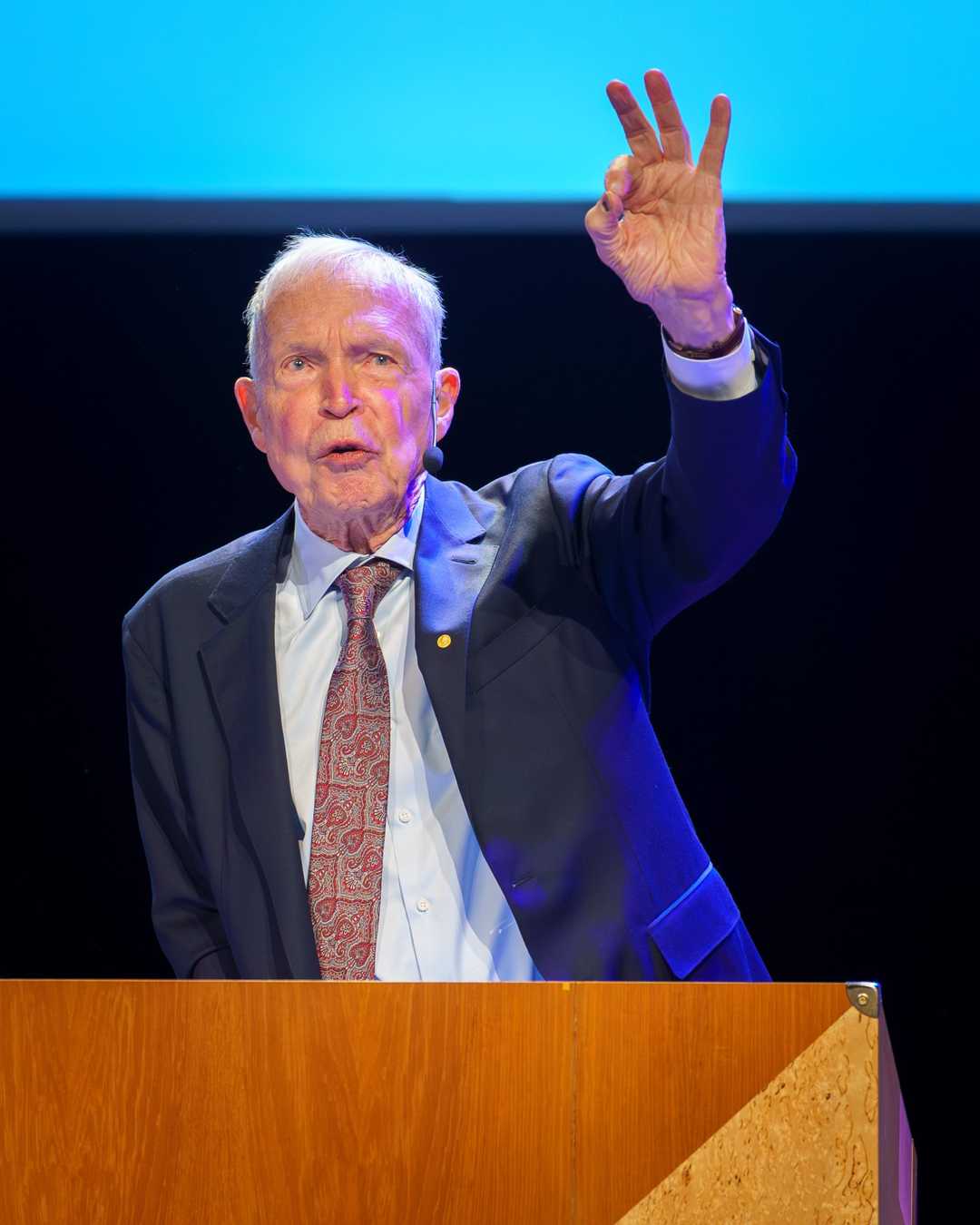
Summary: On April 15, 1982, physicist John Hopfield introduced a transformative model of neural computation, demonstrating how recurrent networks of interconnected neurons could function as associative memories through the principle of energy minimization.
In the spring of 1982, in Pasadena, California, John Hopfield published a seminal work that fundamentally altered the trajectory of neural network research. By applying concepts from statistical mechanics to information processing, he conceptualized a system where the "state" of the network moves toward a stable configuration—an energy minimum—that corresponds to stored memories. This approach allowed computers to reconstruct complete patterns even when provided with partial or degraded input, mirroring the way human memory functions.
| Historical Attribute | Milestone Registry Value |
|---|---|
| Classification Type | person |
| Chronological Date | 1982-04-15 |
| Coordinates / Location | Pasadena, California |
| Curation Authority | Nick Hodder + MIA |
| Milestone Importance | standard Milestone |
How does John Hopfield fit into the history of artificial intelligence?
The 1970s had been a period of stagnation for connectionist models, largely following the skepticism introduced by the publication of Perceptrons Book Published. The AI community had largely pivoted toward symbolic, rule-based systems. John Hopfield disrupted this AI Winter 1 by re-introducing the potential of neural architectures. Building on foundations laid by the McCulloch-Pitts Neural Model, his work provided a rigorous mathematical framework that proved neural networks were not just conceptual toys, but capable of complex information retrieval. His work effectively bridged the gap between biological inspiration and formal physics, laying the groundwork for the eventual surge of interest in deep learning that would follow in the late 1980s.
What are the core technical achievements of John Hopfield?
The primary technical achievement was the creation of the Hopfield Network. This is a recurrent neural network characterized by symmetrical connections between units. The system utilizes an "energy function"—a mathematical representation where lower energy states signify stable, correct memories. When a noisy or incomplete image is input into the network, the system performs iterative updates, descending toward the nearest local minimum in the energy landscape. This process acts like a ball rolling into the lowest point of a valley, effectively "cleaning" the input until it reaches the stored, original pattern. Statistically, a network with N nodes can reliably store approximately 0.14N patterns, providing a quantifiable metric for memory capacity that had been previously elusive in earlier models like the The Perceptron.
Why is the legacy of John Hopfield significant to modern computing?
The legacy of John Hopfield is the legitimization of learning algorithms that operate through iterative optimization. His insistence that network dynamics could be understood through physical analogies opened the door for future researchers like Geoffrey Hinton to develop Boltzmann machines and, ultimately, the Backpropagation Popularized era. Modern techniques in generative modeling and state-space search rely on the fundamental premise established in 1982: that complex, high-dimensional data can be navigated as an energy landscape. By proving that stability and memory were emergent properties of interconnected nodes, he transformed neural networks from abstract curiosities into essential tools for pattern recognition, providing the intellectual catalyst for the eventual shift toward the massive architectures used in contemporary computing.