LeNet Digit Classifier
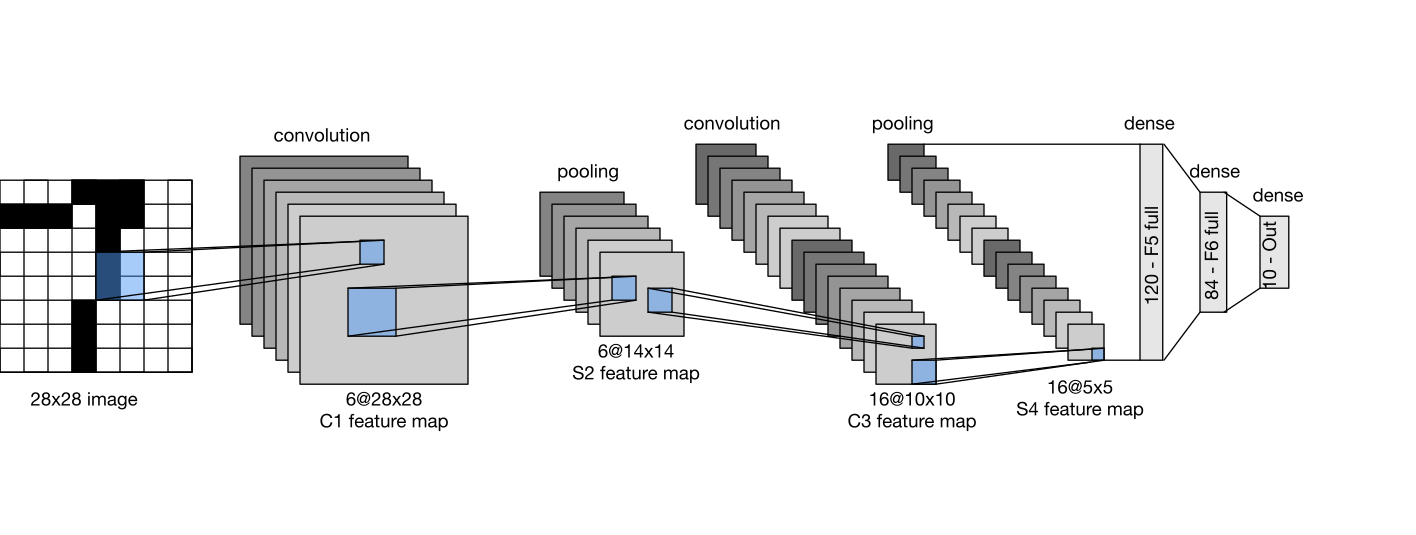
Summary: On June 1, 1989, Yann LeCun and his research team at AT&T Bell Labs introduced LeNet, a groundbreaking convolutional neural network capable of recognizing handwritten digits through a process of hierarchical feature extraction and backpropagation, effectively revolutionizing the automation of mail processing.
In the late 1980s, the challenge of teaching machines to read human handwriting was a significant barrier to administrative efficiency. In Holmdel, New Jersey, researchers at AT&T Bell Labs developed the LeNet digit classifier, a system that fundamentally changed how computers interpret visual data. By June 1989, this software demonstrated that machines could learn to distinguish between handwritten ZIP codes on envelopes with high accuracy, moving beyond rigid, rule-based programming into the realm of true machine learning.
| Historical Attribute | Milestone Registry Value |
|---|---|
| Classification Type | software |
| Chronological Date | 1989-06-01 |
| Coordinates / Location | Holmdel, New Jersey |
| Curation Authority | Nick Hodder + MIA |
| Milestone Importance | godfather Milestone |
How does LeNet Digit Classifier fit into the history of artificial intelligence?
The development of LeNet represents a critical bridge between the early, often frustrated attempts at artificial intelligence and the modern era of deep learning. Following the theoretical foundation laid by the McCulloch-Pitts Neural Model and the subsequent The Perceptron, researchers struggled to create networks that could handle complex, multi-layered tasks. The field had weathered the AI Winter 1 and the AI Winter 2, eras where funding and interest in neural networks plummeted.
LeNet arrived when interest was beginning to cautiously return, fueled by Backpropagation Popularized in 1986. While it built upon the concepts of the The Neocognitron, it utilized supervised learning to refine its internal weights, moving away from the purely unsupervised methods that had stalled previous attempts at hierarchical pattern recognition.
What are the core technical achievements of LeNet Digit Classifier?
The primary technical innovation of LeNet was the convolutional neural network (CNN) architecture. Unlike earlier systems that required manual, hand-crafted features to be defined by a human programmer, LeNet allowed the machine to learn spatial hierarchies of features automatically. It achieved this by employing small, overlapping grids that acted as local filters. These filters traversed the input image—such as a handwritten digit—to identify low-level components like edges and curves, which were then combined into higher-level, complex shapes in deeper layers of the network.
By leveraging Backpropagation Formulated earlier by Paul Werbos, the system could systematically adjust its internal parameters to minimize errors during the training process. In practice, the system achieved a significant reduction in error rates for digit classification compared to traditional statistical methods of the era. This provided a scalable solution for the United States Postal Service, which needed to process millions of envelopes daily.
Why is the legacy of LeNet significant to modern computing?
The legacy of LeNet is foundational to the current state of computer vision. It demonstrated that artificial neural networks could successfully navigate the problem of spatial translation, where a shape (a digit) could appear anywhere in an input field. By proving this approach viable, it paved the way for subsequent iterations such as the LeNet-5 Convolutional Net, which further refined the architectural efficiency of these systems.
The methodology pioneered by Yann LeCun and his collaborators served as the conceptual blueprint for the AlexNet Convolutional Net, which ignited the modern "deep learning boom" in 2012. Without the fundamental shift toward hierarchical feature extraction first successfully demonstrated in 1989, contemporary advancements in automated visual identification and object recognition would have lacked the necessary theoretical and architectural evolution required for success at scale.