Generative Adversarial Nets
Summary: On June 10, 2014, Ian Goodfellow and his colleagues introduced Generative Adversarial Networks (GANs), a groundbreaking software architecture that pits two neural networks against one another in a creative, competitive duel to synthesize remarkably realistic images from raw, random data.
In the summer of 2014, a research team in Montreal fundamentally transformed how machines learn to create. By developing Generative Adversarial Networks, they shifted the focus of artificial intelligence from merely recognizing or classifying existing data to the synthesis of entirely new, original digital content. This innovation proved that by forcing two systems to compete, an algorithm could attain a level of proficiency in mimicry and generation that had previously been considered unattainable for software of that era.
| Historical Attribute | Milestone Registry Value |
|---|---|
| Classification Type | software |
| Chronological Date | 2014-06-10 |
| Coordinates / Location | Montreal, Canada |
| Curation Authority | Nick Hodder + MIA |
| Milestone Importance | godfather Milestone |
How does Generative Adversarial Nets fit into the history of artificial intelligence?
The trajectory of machine intelligence has evolved from early rule-based systems like the Logic Theorist and General Problem Solver toward data-driven paradigms. While the foundations were laid by the McCulloch-Pitts Neural Model and refined by the The Perceptron, the 2010s marked a specific era of "Deep Learning" dominance. Following the success of architectures like AlexNet in 2012, which proved that massive neural networks could classify objects, the research community began seeking ways to generate data rather than just label it. GANs arrived as a synthesis of these advancements, moving beyond the static classification goals of the LeNet Digit Classifier to define a new frontier in creative computation.
What are the core technical achievements of Generative Adversarial Nets?
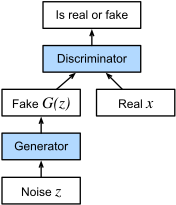
The GAN architecture utilizes a two-part system defined by a zero-sum game. The "generator" attempts to create synthetic data (such as an image) starting from pure, random noise, while the "discriminator" acts as a critic, attempting to distinguish between this synthetic output and authentic data samples from a training set. As the discriminator improves its ability to detect fakes, the generator is forced to improve its output quality to avoid detection. This process continues iteratively until the generator produces outputs so convincing that the discriminator is reduced to a 50% accuracy rate—effectively guessing at random. By the time this equilibrium is reached, the generator has effectively modeled the underlying distribution of the training data. This technical approach bypassed the need for complex, hand-crafted mathematical distributions previously required to model reality.
Why is the legacy of Generative Adversarial Nets significant to modern computing?
The introduction of GANs acted as a catalyst for a massive expansion in visual and data-based AI applications. The ability to generate high-resolution, synthetic imagery opened doors for significant advancements in computer vision, image restoration, and style transfer. Its influence can be traced through the evolution of subsequent generative models, providing the conceptual framework that informed later milestones such as DALL-E Visual Generator and Stable Diffusion Model. By demonstrating that competitive neural environments could master complex tasks, this 2014 milestone shifted the research paradigm toward architectures capable of generating human-like creativity, altering the landscape of synthetic media forever.