Dropout Regularization
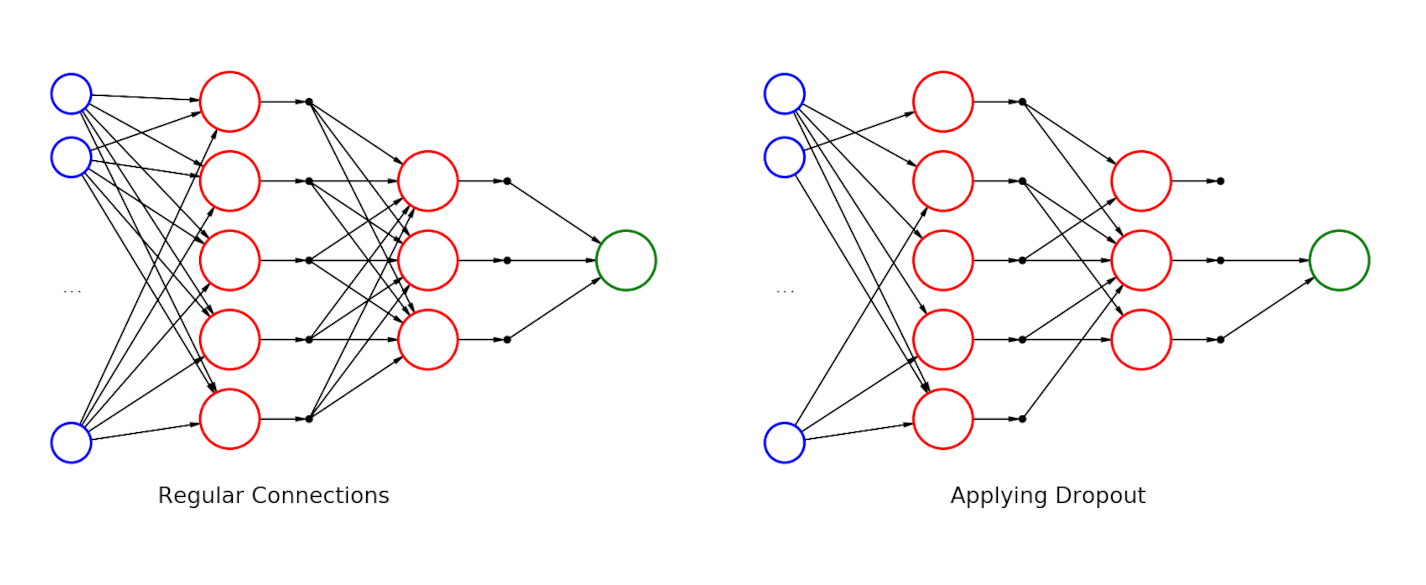
Summary: On July 3, 2012, researchers led by Geoffrey Hinton at the University of Toronto introduced Dropout, a groundbreaking software technique that randomly deactivates neurons during neural network training to combat overfitting and ensure more robust, reliable machine learning models.
In the summer of 2012, computer science reached a significant turning point in Toronto, Canada. Researchers developed a method known as Dropout to solve a persistent problem: neural networks were becoming "lazy" and overly reliant on specific internal pathways, a phenomenon known as co-adaptation. By forcing a computer model to learn without certain pieces of its own architecture on every training cycle, the system was forced to develop multiple, redundant strategies for solving problems. This approach, formally introduced on July 3, 2012, enabled computers to generalize information much more effectively, marking a departure from brittle, over-specialized AI models of the past.
| Historical Attribute | Milestone Registry Value |
|---|---|
| Classification Type | software |
| Chronological Date | 2012-07-03 |
| Coordinates / Location | Toronto, Canada |
| Curation Authority | Nick Hodder + MIA |
| Milestone Importance | standard Milestone |
How does Dropout Regularization fit into the history of artificial intelligence?
The quest for effective machine learning traces its lineage back to the McCulloch-Pitts Neural Model and the later evolution of Backpropagation Popularized in the 1980s. However, as these networks grew deeper and more complex, they encountered the "vanishing gradient" problem, as identified in Vanishing Gradients Identified. Before 2012, researchers often struggled with overfitting—where an AI memorized the training data rather than learning the underlying patterns. Dropout emerged alongside other transformative milestones like AlexNet Convolutional Net, providing the regulatory framework necessary to stabilize massive, data-hungry systems. It acted as a bridge between the early theoretical neural models and the massive, highly capable architectures seen in later developments like the The Transformer Paper.
What are the core technical achievements of Dropout Regularization?
Technically, Dropout operates by randomly selecting a percentage of neurons in a network and temporarily "dropping" them—setting their activation to zero—during each training pass. This prevents any single neuron from becoming overly dependent on the presence of others. By effectively training an ensemble of many different "thinned" networks within a single architecture, the resulting model becomes far more resilient to noise. When tested on datasets like ImageNet Database Project, models employing dropout demonstrated significantly reduced error rates. In standard configurations, setting a dropout rate of 50% for hidden layers proved optimal for many architectures, forcing the network to distribute its learning across a much larger, redundant set of parameters.
Why is the legacy of Dropout Regularization significant to modern computing?
The legacy of this technique is foundational to the current state of artificial intelligence. By mitigating the tendency of models to overfit, Dropout allowed researchers to train significantly deeper networks than previously possible. This success helped accelerate the transition toward deep learning as the dominant paradigm in computer vision, natural language processing, and beyond. Every modern architecture, including those foundational to GPT-3 Language Model or Vision Transformer (ViT), relies on regularization strategies evolved from the original 2012 Dropout implementation. By proving that "breaking" parts of a system could make it stronger, the research paved the way for more reliable autonomous systems and sophisticated reasoning engines, ensuring that AI models could generalize knowledge across diverse, unseen inputs rather than simply repeating memorized training examples.