Deep Belief Networks
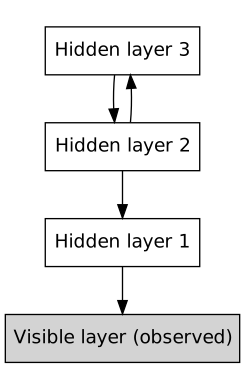
Summary: On July 1, 2006, Geoffrey Hinton, Simon Osindero, and Yee-Whye Teh unveiled a groundbreaking algorithm that enabled computers to learn complex patterns through layered, unsupervised pre-training, effectively ending a long stagnation in neural network research and ushering in the era of modern deep learning.
In the summer of 2006, the field of artificial intelligence was fundamentally transformed in Toronto, Canada. A research team led by Geoffrey Hinton introduced a method to train "Deep Belief Networks," a type of layered computer architecture that had previously been considered too difficult to calibrate. By implementing an approach where each layer of a network learned to represent data independently before the entire system was tuned, the researchers solved a long-standing mathematical bottleneck, reviving interest in the potential of neural computation and paving the way for the sophisticated machine intelligence seen today.
| Historical Attribute | Milestone Registry Value |
|---|---|
| Classification Type | software |
| Chronological Date | 2006-07-01 |
| Coordinates / Location | Toronto, Canada |
| Curation Authority | Nick Hodder + MIA |
| Milestone Importance | godfather Milestone |
How does Deep Belief Networks fit into the history of artificial intelligence?
The trajectory of neural network research encountered significant resistance following the publication of Perceptrons Book Published in 1969, which highlighted the limitations of simple models. While foundational work like the McCulloch-Pitts Neural Model and the emergence of Backpropagation Popularized provided theoretical frameworks, training systems with many layers proved notoriously unstable. For years, the field struggled with the Vanishing Gradients Identified in 1991, where the signal used to train the network would disappear as it passed through deep layers, rendering the system incapable of learning. Deep Belief Networks acted as a bridge between this period of stagnation and the eventual success of architectures like LeNet-5 Convolutional Net, proving that deep structures were not inherently flawed, but simply required more efficient initialization techniques.
What are the core technical achievements of Deep Belief Networks?
The primary technical innovation presented in 2006 was the use of layer-by-layer unsupervised pre-training. Instead of trying to teach the network an output immediately using massive amounts of labeled data, the algorithm treated each layer as a restricted Boltzmann machine. The network would first observe raw data and "guess" the underlying structure layer by layer. This process, often called greedy layer-wise training, allowed each successive layer to build a more abstract representation of the input. Once the weights were initialized through this self-supervised discovery process, a final fine-tuning step was applied using standard Backpropagation Popularized. This two-phase approach ensured that the system began its final training with a highly coherent understanding of the data, effectively preventing the weights from collapsing into useless noise during the initial phases of learning.
Why is the legacy of Deep Belief Networks significant to modern computing?
The impact of this milestone cannot be overstated, as it demonstrated that hierarchies of information could be extracted automatically from unstructured data. By proving that depth was a feature—not a bug—it catalyzed the development of more complex architectures. This shift led directly to the explosion of research that fueled the AlexNet Convolutional Net, which redefined computer vision benchmarks by an unprecedented margin. Furthermore, the methodology provided a blueprint for how to harness increasing computational power, such as the GeForce GPU Coined technology, to handle progressively larger models. Without this foundational success in 2006, the transition toward the massive, multi-billion parameter architectures that define current artificial intelligence capabilities would have been delayed by at least a decade, as the community would have remained preoccupied with the limitations of shallow, single-layer networks.